Showing posts with label Rose Hobart. Show all posts

09 August 2007

On Marginality, Part III

 
This post constitutes the last of three parts about the genesis and implications of Joseph Cornell's Rose Hobart. [Part One] [Part Two]

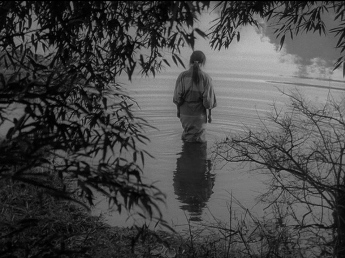
Rose Hobart is no more the key to Joseph Cornell than Rosebud is the key to Charles Foster Kane. And yet there is something essential in Rose Hobart, something beyond star worship and beyond a jocular affection for mismatched eyeline takes. Cornell is, by one light, the most avant-garde of avant-garde filmmakers—not just in his total suppression of narrative momentum but in his expression of concerns defined almost wholly by his status as an avant-garde filmmaker. Rose Hobart is about marginality, among other things—marginality implicit in the act of watching lovely shadows on a screen, marginality as defined by the viewer’s distance to the actress, and, I would like to argue, a kind of kinship through marginality where the distance between enchanted viewer and B-movie actress is bridged by their common home on the cinematic outskirts. He, a moviemaker without a camera; she, an actress whose face rarely graces a trade paper ad, whose private life remains unexploited by the gossip mongers.

Rather than exploiting Hobart as his private plaything, Cornell illuminates the fragility of her persona: his scissors impugn her autonomy no more and no less than those of the studio editors. Out of East of Borneo he creates something new—but it is a form fully conscious of the newness of East of Borneo, its own cuts just as phantom as his. Cornell, I think, understood that, properly speaking, there may be one East of Borneo—a sordid little eight-reeler running seventy-four minutes—alongside a countless number of alternate versions: heavily scratched 35mm copies; dupey 16mm reduction prints (as was the material source of Rose Hobart); this particular reel or that one; this moment or that one; East of Borneo as a sourcebook of delirious fantasy; East of Borneo as imagined by the child who has heard about it but not seen it yet; East of Borneo as imagined by an adult who read Morduant Hall’s Times review and hesitates to buy a ticket; East of Borneo as remembered after the house lights rise again the theatre, or perhaps inadvertently for the first time after the space of many barren years, now available only as a series of fragments and incomplete gestures. Rose Hobart is a reverie of East of Borneo: the images that come to one’s mind when another speaks its title, accompanied by the sounds of Brazil—not the real sounds of Brazil but the atmosphere of Brazil the arm chair voyager accesses through a Nestor Amaral LP. Its star Rose Hobart is cast adrift in the ether of memory and photography, her image only made meaningful and full again through a sympathetic viewer. As in Warhol’s later silkscreens of Marilyn Monroe, only through extreme artifice—that is, visions blatantly truncated from their original commercial context and presented anew—are the ubiquitous star images allowed a measure of unsuppressed personality.

Though composed five years after the premiere of Rose Hobart, a brief Cornell piece from View magazine on Hedy Lemarr seems still the best guide for understanding the artist’s method and motivation:

Among the barren wastes of the talking films there occasionally occur passages to remind one again of the profound and suggestive power of the silent film to evoke an ideal world of beauty, to release unsuspected floods of music from the gaze of a human countenance in its prison of silver light. But aside from evanescent fragments unexpectedly encountered, how often is there created a superb and magnificent imagery such as brought to life the portraits of Falconetti in “Joan of Arc,” Lillian Gish in “Broken Blossoms,” Sibirskaya in “Menilmontant,” and Carola Nehrer in “Driegroschenoper?”

And so we are grateful to Hedy Lamarr, the enchanted wanderer, who again speaks the poetic and evocation language of the silent film, if only in whispers at times, besides the empty roar of the soundtrack…. At the end of “Come Live with Me” the picture suddenly becomes luminously beautiful and imaginative with its nocturnal atmosphere and incandescence of fireflies, flashlights, and aura of tone as rich as the silver screen can yield.

Even a viewer more sympathetic to the talkie revolution than Cornell is apt to see his point; Hollywood photography between 1931 and 1941—that is, between East of Borneo and Come Live with Me—seems, to my eyes at least, a golden age of studio photography, the decade during which even the shoddiest of Hollywood features possessed—either through accident or through simple competence—a few glimmering moments. To cite two examples from the beginning of the cycle: neither John Francis Dillon’s 1932 sleaze sideshow Call Her Savage or Sidney Franklin’s 1931 adaptation of Private Lives is a masterpiece, but each contain moments of shimmering glamour that accord Clara Bow and Norma Shearer all the luminance of Dietrich in a Sternberg Valentine. The same holds true for Karl Struss’s work on The Story of Temple Drake or Joseph Walker’s on It Happened One Night, a Poverty Row quickie turned Academy darling thanks to unexpected Heartland popularity, with moments of lyricism worthy of comparison to Murnau’s Sunrise.

What Cornell saw in East of Borneo and Come Live with Me—and what any astute film historian can see given the chance to view most any two random studio programmers from the thirties—is a kind of unconscious grace hidden amid the studio rubble. Note Cornell’s adjective enchanted—the mortal Hedy Lamarr (or Rose Hobart) possessed by the spirit of art without being aware of it. The unconscious part is key: art created accidentally, almost in direct contradiction to one’s orders and plans, a serendipitous moment of beauty that slipped past everyone’s notice. Cornell’s role of curator is a fiercely democratic one—revealing the unconscious depths of poetry within the damaged goods of forgotten product. Cornell may make East of Borneo unintelligible on the level of plot, but he simultaneously makes legible its unintended poetry. No accident that Rose Hobart is framed by an eclipse—everything in between is one long, privileged moment, a journey into the ideal world of beauty that only happens once in a blue (or, in some prints, pink) moon.

30 July 2007

On Marginality, Part II


This post constitutes the second of three parts about the genesis and implications of Joseph Cornell's Rose Hobart. [Part One] [Part Three]

Incomplete is neither an epithet nor a judgment of Rose Hobart so much as a sad historical fact. The urtext of Cornell’s first film is frustratingly elusive: while all the extant copies of the film adhere to the same montage (a mélange of East of Borneo, along with some unidentified stock shots), the performative aspects of Rose Hobart have been in some state of dispute since 1936. For its premiere at the Julien Levy Gallery, Cornell reportedly screened his 16mm print of Rose Hobart at silent speed, through a blue glass, with musical accompaniment from a Nestor Amaral record Holiday in Brazil. Though ‘silent speed’ can refer to a range of different frame rates, Rose Hobart is usually screened or transferred to video at 18 frames per second—the probable ‘silent’ preset on most portable 16mm projectors—resulting in a uniform length of 19½ minutes. Color and sound are more contentious. When the first digital incarnation of Rose Hobart was presented on the fourth disc of the National Film Preservation Foundation’s Treasures from American Film Archives DVD boxset in 2000 (an expensive niche set, but still easily the widest distribution and exposure ever given to Cornell and his films), the film, taken from an Anthology Film Archives print, was bathed in deep lavender and accompanied by three tracks from the Amaral album—two instrumental and another vocal, called ‘Playtime in Brazil.’ When the film was released on Magical Worlds of Joseph Cornell disc put out by the Voyager Foundation through the Museum of Modern Art four years later, the color was a pale blue-purple and the soundtrack featured only two songs—both instrumental, and only one the same as on the Anthology/Treasures copy. To further complicate the matter, the Walker Museum holds a pink print of Rose Hobart—also the tint of the color plates from the film in David Bordwell and Kristin Thompson’s widely-assigned Film History: An Introduction textbook. One suspects, though, that Cornell—an artist highly enamored of interactive objects, though that point is obscured when his boxes are presented under glass in museum collections—may have liked, or even wanted, it this way. [1]

The Rose Hobart premiere is a storied event in the history of both modern art and avant-garde cinema. The legend is famous enough—an exasperated Salvador Dali interrupts the film, screaming “Salaud!” and (in some versions) kicking over the projector. The timid Cornell, legend has it, wondered aloud ‘Why, why—when he is such a great man and I am nobody at all?’ (Dali’s official reason for mischief: he had once considered making a film exactly like this, but never wrote it down; Cornell had stolen it—from his subconscious). The riot of one was enough to frighten Cornell away from showing his films publicly for three decades. Private screenings at the Cornell colonial on Utopia Parkway in Queens were the only way to see the film. Nevertheless, the absence of Rose Hobart from most accounts of film history until recently is still rather mysterious, especially given that the leading mainstream American film historian of the thirties, Lewis Jacobs, author of the ubiquitous The Rise of the American Film, was also himself an avant-garde filmmaker (Footnote to Fact, Tree Trunk to Head) of some repute in New York and a chronicler of that New York avant-garde scene in a 1949 survey published in Roger Manvell’s international Experiment in the Film anthology. The film history textbook trade, even when conceding space to Stan Brakhage, Hollis Frampton, and loose antecedents like Ralph Steiner, neglected Cornell’s films for many years; one will not find a reference to him in anything by Gerald Mast or Louis Giannetti.

Even most purported histories of the avant-garde or underground cinema sidestep the Cornell problem, either entirely (c.f., James Peterson’s Dreams of Chaos, Visions of Order; David Curtis’s Experimental Cinema: A Fifty-Year Evolution; A.L. Rees’s A History of Experimental Film and Video, published in 1999 when Cornell’s films were certainly in circulation; or the History of the American Avant-Garde Cinema catalogue issued by the American Federation of the Arts) or reference Cornell’s later collaborations with Brakhage, Rudy Burckhardt, and Larry Jordan without discussing Rose Hobart at all (c.f., Sheldon Renan’s An Introduction to the American Underground Film). To their credit, P. Adams Pitney and Dominique Noguez (the latter writing in French) analyze the film and attempt to ascertain its influence in their respective histories, Visionary Film: The American Avant-Garde, 1943-1978 and Une Renaissance du cinéma: le cinéma “underground” américain—though both record East of Borneo as a Columbia release. Sitney even helpfully prints a hitherto unpublished Anthology Film Archives interview with Ken Jacob that puts to rest any assumption about the film’s influence on subsequent avant-gardists:


I was seeing Jack [Smith] again and I told him, “Jack, you’ve got to see this movie.” We looked at it again and again, and we were both knocked out. Jack tried to act at first like a little bit removed, like I was overstating it, and then he broke down and said, “No, it’s very good.” We looked at it in every possibly way: on the ceiling, in mirrors, bouncing it all over the room, in corners, in focus, out of focus, with a blue filter that Cornell had given me, without it, backwards. It was just like an eruption of energy and it was another reinforcement of this idea I had for making this shit film [Star Spangled to Death] that would be broken apart and then again there would be an order.

The circumstances of the premiere being what they were, one would expect some astute historian to seize upon the December evening as the American cinema’s Rite of Spring. Such a reading would, in the very least, be firmly in line with subsequent Cornell scholarship, which repeatedly revels in an almost gawking conflation of the artist’s life and work. Joseph Cornell: earl of Utopia Parkway, outsider artist toiling in his basement on brilliant Surrealist boxes to entertain his retarded brother to the indifference of his ailing mother. A homebody who never left New York, haunting recital halls and finding his artistic inspiration in antiquarian bookstalls. Never married, perhaps a lifelong virgin, definitely an innocent—a would-be queer aesthete had he known he could be one. In short, a kind of nebbish savant for the art world set. Although Cornell did not screen Rose Hobart publicly for many years, one obviously cannot and should not assume that Rose Hobart remained locked in storage unseen; Cornell screened the film privately and even lent it out on occasion.

Whether it is Sandra Leonard Starr’s reading that appraises his art through the lens of Church of Christ, Scientist founder Mary Baker Eddy and her writings or Michael Moon’s ‘revisionist’ reading that locates Cornell’s style in his fondness for sugar pixie junk food, the overriding tendency is to deify Cornell as an accidental, improbable, and dingy genius. Yet the biographical evaluation of Cornell is oftentimes so intent on mythologizing Cornell (as blissful dreamer, as lunatic seer, as self-styled schlemiel redeemed through homespun surrealism) that it obscures the Cornellial contradictions that account for most of his mystique. Cornell’s domestic difficulties and many accounts of odd pilgrimages to Utopia Parkway (c.f., that of John Ashbery) suggest an outsider artist par excellence, but before establishing Cornell as the patron saint of Art Brut, one should remember that he exhibited in the same gallery as Ernst, Dali, and Duchamp, served as a designer for Dance Index magazine, corresponded with Susan Sontag, hobnobbed over Kool Aid and cafeteria jellyrolls with John Lennon, Yoko Ono, and Andy Warhol, and lived the life of an amateur scholar much more than most are comfortable in admitting. Cornell’s knowledge of nineteenth-century theater and ballet, accrued from long days at the New York Public Library, was deep enough to make him a world authority on the subject. His pack-ratting was widely known and Cornell was enlisted to lend bits and pieces of his disorganized picture collection to MoMA and the NYPL for, respectively, a 1933 exhibition of film stills and a 1950 fairy tale exhibition. 

Even the standard interpretation of Cornell’s filmmaking—whether Jodi Hauptmann’s Mulvey-inflected analysis of Cornell’s exploitative gaze or Noguez’s description of Rose Hobart, ‘un bel album de "fan" cinephage’—tends to present Cornell’s cinephilia as slightly unhinged fan behavior, at the expense of considering Cornell as a true film historian. In a survey written for a MoMA catalogue on Cornell, Sitney quotes from an unfinished letter Cornell wrote to French film historian Claude Serbanne in 1946:

Still I think we owe [Ferdinand Zecca] a debt for doing what melies seldom did,—working en plein air, leaving a record Atget-like of so many of the Parisian fin-de-siecle landmarks (the unpretentious ones like the boutique of a charcutier such as I have in my “The Man with the Calf’s Head” which Dali liked so much and in which he [sic] a quality of Gérard de Nerval. And then again this type of work influenced René Clair in his early work.)

That film history has still, by and large, failed to meaningfully assimilate Zecca into its grand narrative makes Cornell’s remark all the more beguiling. The difficulty lies in reconciling the Cornell mythos—a junk collector buying up random 16mm films by the pound from a seedy Jersey shore scrap yard, which, again, comes from Levy—and the evidence that he acted, on occasion, as a surprisingly sensitive art historian.

So Cornell remains a most perplexing enigma: neither urbane nor innocent, neither savvy nor vulgar, a great man who insisted he was a nobody or a nobody who everyone else pretended was a great man
.

 
[1] A further error is implicit in Levy’s recollection of the premiere, found in his Memoir of an Art Gallery, probably the only extant account of the first screening of Rose Hobart and certainly the one that all other accounts draw upon. According to Levy, Rose Hobart was preceded by Marcel Duchamp’s Anemic Cinema, Man Ray’s L’Etoile de mer, and an earlier Cornell’s film entitled Goofy Newsreel. While Levy does not write about Goofy Newsreel in much detail (other than to point to its ‘unfortunate title’), he does imply that it is a Cornell film—as opposed to the program of films Cornell occasionally hosted under the Goofy Newsreel banner. P. Adams Sitney’s report on Anthology Film Archives’ Cornell holdings does not mention any extant film called Goofy Newsreel and it is quite likely that Levy confused Cornell’s usual assortment of silent shorts with a carefully edited film proper like Rose Hobart.

17 July 2007

On Marginality, Part I

 
This post constitutes the first of three about the genesis and implications of Joseph Cornell's Rose Hobart. [Part Two]. [Part Three].
On 21 June 1930, Universal Pictures announced twenty forthcoming films in its Universal Weekly trade paper, among them an unassuming jungle thriller called Ourang:

A startling dramatic romance filmed in the unexplored wilds of Borneo. Unique with almost unbelievable thrills and overflowing with virgin jungle color. The picture tells an absorbing tale of love and sacrifice in which a white derelict and a native girl find the only road to happiness stemming the stampede of the fierce ourangutans [sic]. Filmed by an expedition headed by Harry Garson.

Universal never completed, let alone released, Ourang. The demise of the project is unrecorded, but Garson incorporated most of the Universal footage into his subsequent feature The Beast of Borneo, issued in 1934 by his ad hoc road show company Far East Productions, Inc. By the time The Beast of Borneo was taken off the shelf, Universal had already recycled Garson’s Ourang footage for its 1931 Rose Hobart vehicle called (fittingly) East of Borneo.

Despite an aberrational sensation like All Quiet on the Western Front, Universal was a minor studio at the dawn of sound. Its assets hovered at $15.5 million in 1931—ahead of Columbia’s $6.35 million, but far, far behind the $173 million of Fox, the $213 million of Warner Brothers, and the $306 million of Paramount. East of Borneo was a cheap picture for a cheap studio, shot in four weeks by director George Melford.

Melford had been directing films since 1911. By the early thirties, the best gig he could find was Paul Kohner’s unit at Universal. Kohner headed the studio’s Spanish language unit—a truly marginal little department that turned out full Spanish language versions of the bigger studio properties (shot after hours on the same sets as the English versions, but with entirely different casts and crews) before the studios settled on dubbing as its standard for distributing their fare internationally—and hired Melford to direct a few features, despite the latter having no knowledge of the language. Given their working conditions, Melford and Kohner ground out a remarkable product—including their 1931 Spanish version of Tod Browning’s Dracula, by common consensus superior to the English version in every technical respect but not screened outside of Latin American cinemas for decades. Given the thriftiness of the unit, the trade buzz on East of Borneo—namely that the shoot was “begun in Sumatra, Shanghai, and the Far East by a sound-equipped expedition”—is rather difficult to swallow, unless read as an oblique reference to the Ourang expedition. East of Borneo, despite its English soundtrack, is every bit as threadbare as Dracula; Melford even recycles that film’s leading lady, Lupita Tovar, in a smaller role (though East of Borneo exploits Miss Tovar’s cleavage with aplomb equal to that of Dracula).
 
East of Borneo opened at the RKO Mayfair in New York on 25 September 1931, playing on the top half of a double bill with Murnau’s even more exotic Tabu (recently reduced to “popular prices”). The New York Times noted that East of Borneo ‘has its full quota, in fact a plethora, of jungle thrills.’ The Times’ Mordaunt Hall (clearly not the target audience for the film) admits at the end of his review that amid the amusing but juvenile pleasures of the jungle spectacle one finds ‘Miss Hobart ... serv[ing] the picture in her usual intelligent fashion.’ Variety’s review, published four days later, opened this way:

Sensational jungle and animal story loaded with thrill and natural for the neighborhood trade, even if it is pretty naive in treatment for the deluxers. For the class spots, however, it is promising for a week. Picture that ought to be great in the right places and moderately strong anywhere except blue-stocking clienteles.

Variety, too, singled out Hobart, noting she “plays a stilted role with the maximum of plausibility, and is even more than ever suggestive of Norma Shearer.” Another trade review, published as a preview in the 23 August issue of Film Daily, was more enthusiastic, calling East of Borneo “a colorful Oriental jungle meller that has practically everything ... it pours in everything of showmanship with prodigal profusion.” Photoplay wrote that East of Borneo was “a splendidly photographed thrill-story … exciting enough and beautiful enough to satisfy theater-goers with adequate work by Charles Bickford, Rose Hobart, and Georges Renavent.” neglected the matter of Hobart’s performance, they rated the direction “excellent” and the photography “the best”—the highest accolades Film Daily accorded to any of that week’s eight previews. Photoplay wrote that East of Borneo was “a splendidly photographed thrill-story … exciting enough and beautiful enough to satisfy theater-goers with adequate work by Charles Bickford, Rose Hobart, and Georges Renavent."

Universal touted the early success of East of Borneo with a subsequent ad in Film Daily (“universal gave rko a smash picture[.] rko gave it a smash ad campaign[;] a smash lobby ... a smash 24-sheet campaign[;] a smash exploitation resulting in smash business at rko’s mayfair), but the picture was not a sustained success: in the 1932 Film Daily Yearbook, Universal’s ad read, “The company that gave you frankenstein and strictly dishonorable takes great pride in calling your attention to this imposing list of hits,” followed by two columns of twenty-three titles—East of Borneo buried in nineteenth place. The next page of Universal’s big ad buy featured a full-page publicity pic of studio head Carl Laemmle, Jr., followed by one of Strictly Dishonorable director John M. Stahl. Similar treatment was never accorded to marginal Melford and East of Borneo failed to crack the top fifty of the Film Daily Yearbook critics’ poll. So after a circuit of cheap runs, the picture built from the scraps of the never-completed Ourang disappeared from public view. That is, until December 1936 when Joseph Cornell would take the scraps of East of Borneo and fashion his perpetually incomplete masterpiece Rose Hobart.