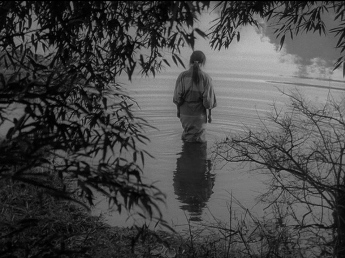
These program notes were written for the Rochester premiere of The Exiles on 21 and 22 November 2008 at the Dryden Theater at the George Eastman House. The always intrepid Milestone will be releasing a DVD of The Exiles, which will include four (!) Mackenzie short films and too many other supplements to list here, on 17 November 2009.
The Exiles
Production Credits
Director/Writer/Producer: Kent Mackenzie ● Photography: Erik Daarstad, Robert Kaufman, John Morrill ● Music: The Revels
Principal Cast
Yvonne William, Homer Nish, Tommy Reynolds
Country of Origin: USA ● Year: 1961 ● Running Time: 72 minutes
Because The Exiles has finally received its first theatrical release some forty-seven years after its completion, it is tempting to regard it as a film understood better now than then, a recovered masterpiece. Yet as an independent production from the early 1960s The Exiles is hardly an aberration. The erosion of the studio system during the 1950s had allowed talented upstarts like Stanley Kubrick and Samuel Fuller to land studio contracts after attention-grabbing low-budget successes. This was the period that saw resolutely challenging films from the likes of Stan Brakhage and Bruce Baillie and relatively more commercial incursions from John Cassavetes, Shirley Clarke, and Lionel Rogosin. The film festival circuit was growing each year and every film school student had a shot at the big time.
In this respect The Exiles achieved almost blessed success. How many student films receive a world premiere at the Venice Film Festival, go on to festival engagements in Mannheim, San Francisco, London, Chicago, and Edinburgh, and land on the cover of Film Quarterly? This for a film begun by a group of friends from the USC Cinema Program holding down workaday jobs on the margins of the industry and shot piecemeal over the course of almost three and a half years. If anything, The Exiles would serve as an inspiration to film students everywhere—indeed, the Screen Director’s Guild gave Mackenzie a $1,200 scholarship to write a master’s thesis on his theory and practice. By that time Mackenzie had already liquidated his savings to finance the film and secured donations from his brother-in-law, his barber, and countless others.
Although The Exiles is in many ways a prime exemplar of its vibrant moment it is also quite an exceptional piece. Many independent landmarks of the period were shot with lightweight, flexible 16mm cameras but Mackenzie and his cinematographers made The Exiles in 35mm with a borrowed camera. They shot some 50,000 feet of negative from unused 300-foot scraps purportedly salvaged from Desilu Studios and, on another occasion, a plane crash.
How Mackenzie and his crew procured the means of production makes a curious anecdote; what they did with it proved more interesting. The Exiles has been described as a piece of documentary fiction—and indeed Mackenzie’s free-form compositions and his unorthodox way of letting them flow together is quite unlike anything seen in Hollywood narrative films in 1961. It is not wrong to compare Mackenzie to Jean Rouch or Jean Vigo or any number of other then-influential French filmmakers whose films danced on the line separating documentary from fiction. It is not wrong but not right either. At first glance many shots in The Exiles seem like marvelous feats of guerrilla filmmaking—scenes coaxed out of any available light in a dank bar or an alley. In fact these scenes were highly choreographed and their lighting meticulously planned to give the impression of documentary naturalism. There is also the matter of the rather dense soundtrack: all the dialogue was dubbed in a studio, months or years after the scenes had been photographed. The music, seemingly all tunes overheard from the radio, is all the work of one high school band, The Revels, here accorded the illusion of zeitgeist cachet.
Mackenzie’s account of his method confounds as much as it clarifies: “No theatrical or documentary approach—in which a problem is stated and the decisions and actions of the characters proceed either to achieve or suggest a pat solution—seemed suitable for the film. The situation in which these people are involved could not be brought to a stage and reenacted. The thousands of details involved in their environment could never be duplicated …. We sought to photograph the infinite details surrounding these people, to let them speak for themselves, and to let the fragments mount up. Then, instead of supplying a resolution, we hoped that somewhere in the showing, the picture would become, to the viewer, a revelation of a condition about which he will either do something, or not — whichever his own reaction dictates.”
The Exiles oscillates between social inquiry and professional calling card: it’s a film that critiques the inadequacies of the documentary idiom while striving to emulate it. The film is not unlike a master’s thesis: it demonstrates the depth of the candidate’s research (Mackenzie boasted of his anthropological surveys and his data from civic groups, government agencies, and interested observers) and his formal sensitivity.
How much The Exiles can actually teach us about its ostensible subjects—American Indians, life off the reservation, working class struggles at midcentury, or a Bunker Hill soon made unrecognizable by urban renewal—is up for debate. (For his part, Mackenzie maintained the Indians did not regard him as an outsider or an opportunist. “It was more important that we’d promised them a party,” he said.) The political reaction on the festival circuit was mixed: an award in Venice and skepticism elsewhere, with reports that audiences found the Indians “unpleasant” and “distasteful,” the portrayal of their plight “unsympathetic.” The U. S. State Department was no fan either.
Mackenzie continued to work on The Exiles for some years; in a bid for distribution he chopped the film from 77 to 72 minutes and added a (heavy-handed) prologue about the Indian in America illustrated with some Edward S. Curtis photographs. In 1964 The Exiles received a slot in the inaugural New York Film Festival line-up, but the distributors remained largely indifferent; Pathe Contemporary made 16mm prints available to the classroom market but did not entertain a theatrical run.
Thus while The Exiles has always been with us in a subterranean way (similar, in fact, to the fate of Killer of Sheep) it was not widely seen or remarked upon. Thom Andersen’s approving citation of the film in his 2003 video essay Los Angeles Play Itself sparked renewed interest in Mackenzie’s work. The original 35mm elements were found in a USC archive and brought to UCLA Film & Television Archive, whom we have to thank for the present sparkling restoration. Today, ironically, The Exiles’ value as a not-quite-documentary record of a vanished lifestyle substantially outweighs the limitations of its affectations.
For Further Reading
Hunter, Benjamin, “Film Review” [The Exiles]. Film Quarterly, Spring 1962, Vol. 15, No. 3, pp. 59-62
29 August 2009

26 August 2009
Woman is the Future of Man: El Sexo Fuerte (1946)
I suspect that we do not have the critical vocabulary or temperament to adequately understand this unaccountable Mexican film. It is too ridiculous to be confused with art and too colored by legitimate social feelings to be dismissed as camp.
That some political message was built into El Sexo Fuerte (The Strong Sex, which screened last week at UCLA) and then tugged and slapped to within an inch of its life is apparent. Two men from modern day Mexico wash up in the Kingdom of Eden, a futuristic art deco fiefdom ruled by sexless harpies who nevertheless maintain harems made up of no less than seven bearded codgers old and harmless enough to be their grandfathers. The clean-shaven hombres are sold at auction (with one fetching an all-time high of 2,000 cows)—only to be “nationalized” and made to serve as royal manicurist and waiter. But a revolution is afoot: the Party of Authoritarian Masculinity stalks the underground and plots a patriarchal restoration. The queen’s cabinet falls prey to animal instincts and the whole kingdom is swept up in a mango epidemic (!) that can only be cured by locking lips. Soon the Masculinists have achieved their coup and embarked on a re-education campaign that emphasizes proper Mexican courting rituals and domestic duties.
The final scene goes further still. Patriarchy has been restored and the first couple enacts a typical domestic scene. The woman breathlessly renounces self-determination at every turn but henpecks her husband into kinky submission. Ceding the political sphere but retaining an entirely different (and, it is suggested, more important) will to power, this woman embodies the stealthy power of hearth and home.
This quite abbreviated summary lends perhaps too conventional a sense of structure to El Sexo Fuerte. It smoothes out the abrupt and incoherent ideological ruptures. It begins as a satiric spectacle of the contrafactual; visions of men crocheting and meekly conspiring towards civil rights are too absurd to be interpreted as anything but a critique of the ruling order. The cognitive dissonance cannot help but radicalize even the most conservative viewer. But before long it becomes an apparently reactionary tribune of nationalist machismo, a cozy affirmation of the very things it has already indicted. Women can trounce around like statesmen and soldiers and carry cardboard ray guns but men can never be feminized.
More than a polemic, El Sexo Fuerte exceeds the value of any pure tract—it is an unconscious catalogue of free-floating sentimental resentments, imagined anxieties, repressed acknowledgments, half-truths and projections. It is more than a document of contradictory attitudes. It’s closer to sincere self-critique on an industrial scale—a national monument to feelings that cannot be uttered aloud. For a film that fails to stake out any ideological position for more than ten minutes, it nevertheless manages to put forward gender as performance, sex as the currency of political economy, entertainment as the apparatus for indoctrinating femininity, and half a dozen other subterranean avant-la-lettre feminist critiques.
There is no mise en scene to speak of. The same five or six sets are recycled and pilloried for every incident. The actors suppress so many internal contradictions to make up for the muted external dynamism. At its best El Sexo Fuerte comes across as a sporadically committed fusion of a Flash Gordon serial and Female, the infamous Warner pre-Coder that finds mankilling auto titan Ruth Chatterton unexpectedly renouncing corporate largesse for romance. It is as much about sexual politics as it is about the erotic thrill of caressing polystyrene shoulder pads. Its world is modernity’s deranged imagination of itself, with gears and gurneys and industrial film junk irrationally re-appropriated for interior design. Model cars whiz along the miniature highway. The costumes permit a leering gaze at purportedly post-sexual women. A line of sombrero-clad mariachi chorines emerges as the ultimate image of reconciliation.
The director of record is Emilio Gómez Muriel, either a major unrecognized talent or the most damning refutation of the auteur theory yet unearthed.
POSTSCRIPT
Aaron Greenberg—who likes the film as much as, if not more than, I do—adds the following thoughts:
Women in power upset the natural order. No sex, no romance; just emotionless and powerful. But the movie also recognizes the arbitrariness of the situation – who counts as powerful and weak, man and woman, depends not on essential biology, but political contest.
To my mind the film’s most radical conceit comes in its exaggeration of gender inequalities, which also makes its later sanctioning of it so interesting. The women constantly remind the frightened, monkish men that their situation is natural and (therefore?) attractive – something that men in power don’t even need to do!
So, on the one hand, the movie recognizes that gender and power are mobile and move together. But everyone suffers with women in power; they’re ice queens and prudes who deny sexual and romantic life – which makes you wonder why they have so many men around at all, especially given that there’s no fucking or birthing going on. [It is asserted at one point that the women order babies from Paris, just like any luxe commodity. – K.A.W.] But with men in power, natural (or familiar?) romance and sexuality are restored: women get want they want, men get what they need.
The ideological acrobatics are amazing: the film both ironizes the “naturalness” of different power arrangements, but still resolves to patriarchy. Gender might be performance or convention, but (anatomical?) men are men and (anatomical?) women are women.
The film both yields moments of radical recognition and remains very interested in getting the audience off. In yet another register, it participates in exactly the attitudes it seems to be calling into question.
The women probably haven’t had sex since the revolution, and they hardly have to impress their cuckolded husbands, but they still run around in mini-skirts and high-heels to titillate the male audience. But this makes so much sense given the film’s strange logic: genders are mobile but (anatomical) women still need manicures and perms.
The ending puts women in their place, out of political power, but in possession of their natural powers of persuasion. Even when men rule, women still have power because men are stuck needing them, wanting them, and hating them all at once. The film mistakes men’s affective attitudes towards women for women’s real, structural power.
22 August 2009
LACMA and the Crisis of Repertory Cinema Advocacy
The Los Angeles County Museum of Art (LACMA) has aroused considerable and well-deserved controversy in the wake of its 28 July announcement that it would be shuttering its film program after 41 years. Senior matinees may remain and a nebulous thing called “artist-created films” might return at a later date.
The program’s financial loss--$100,000 annually (though some well-connected sources peg this closer to $70,000) and $1 million over the last decade—is cited by Museum Director Michael Govan as the reason for dismantling the one-man Film Department. Having run a repertory cinema that screened a different film every night, those figures strike me as frankly trumped up for a program that runs a few nights a week and often offsets rental and shipping costs of international material through third party sponsorship. Might they also include building maintenance costs dropped onto the Film Department’s balance sheet? Is programmer Ian Birnie’s salary counted as a loss?
This raises other questions, of course: would curators of painting, sculpture, or even photography face similar pressures? Would their departments be shuttered on the basis of low foot traffic? Would a six-figure shortfall in those instances be called a loss or the cost of doing business? Calling it the former is already something of an ideological concession. Operating expenses are precisely that—the cost of an institution fulfilling its mission, in this case “[t]o serve the public through the collection, conservation, exhibition, and interpretation of significant works of art from a broad range of cultures and historical periods.” Which the film program does.
But let’s return for a minute to the matter of money. Institutions around the country that rely in large part on donations and endowments for their operating budgets—universities, art museums, and the like—are certainly in dire straits in the current economy. Donations have dramatically decreased and many endowments have lost a large portion of their value or have become frozen, meaning that their interest cannot be tapped to cover budget shortfalls. Layoffs are common in the non-profit sector these days.
For all that, $100,000 is still a comparatively small sum for a museum. Insurance policies for so-called blockbuster exhibitions exceed it many times over. But even assuming that $100,000 is the correct figure, it still constitutes less than two-tenths of one percent of the Museum’s $74 million annual operating budget. Without being too crude about it, LACMA does not feel that film screenings constitute even two-tenths of one percent of its mission.
Which is to say that LACMA does not feel that film belongs at its museum. No major component of a museum would be sacrificed in a time of fiscal difficulty if it were not valued in the first place.
Ignore for a moment Govan’s lavish salary ($6 million over five years, plus benefits) and focus instead on the language found in the recent Los Angeles Times article that disclosed this salary:
"The reputation of LACMA was not a good one," said Bobby Kotick, a trustee who heads the company Activision Blizzard, maker of the video game Guitar Hero. "There was definitely skepticism whether L.A. was committed to building a cultural institution that would be on par with the Met and MOMA. . . . Compensation was one way to overcome that."
Indeed. And it follows that another way of overcoming this reputation was axing an extraordinarily cheap program that obviously does not have the approval of the trustees. Such an action demonstrates exactly where the Museum’s priorities lie and cannot be interpreted otherwise.
As repertory cinemas go, LACMA was quite successful, recently hosting four sold-out screenings of Carlos Reygadas’s austere but beautiful masterpiece Silent Light, the only thing resembling a ‘run’ that that film received in Los Angeles.
Govan has spoken of finding a donor to underwrite the film program. Resentful letter writers and blog commenters have advanced the idea that Hollywood studio heads or rascals like Martin Scorsese should pony up instead of being typical showbiz hypocrites. (In the case of Scorsese, this is quite a charge; his Film Foundation dispersed over $1.4 million for film preservation in 2008 alone.) These sentiments and overtures are disingenuous.
In 2008 LACMA reported over $129 million in gifts, including over $6.5 million in unrestricted gifts. (These are the donations that are mercifully, as the name implies, unrestricted and can be used to meet general operating expenses without the stipulations placed on the great majority of donations.) Doubtless LACMA has already found urgent needs to which these unrestricted funds may happily be applied. Even in this economy, though, $100,000 funneled to the film program is a drop in the bucket. But the point remains and by now defies credulity:
The future of the film program at LACMA is not at the mercy of individual donors and their heroic deeds. The dismantling of the film program, which requires a truly miniscule portion of the Museum’s operating budget, is not an unfortunate accident but instead an ideological prerogative.
What can be done about this?
In the short term, there is a petition online that presently has close to 2,500 signatures.
The effort is sponsored by a blog, savefilmatlacma.blogspot.com. It has an affiliated facebook group and twitter feed.
Given LACMA’s obvious mistrust of film, however, I fear that these efforts might not be sufficient. This is not a slight towards the petition, nor the blog, but rather a call for something larger.
As demonstrated by the national (and indeed, international) rebukes of this move, the implications of the dismantling of LACMA’s film program are wider than Los Angeles County or the L.A. repertory scene. Articles forecasting the demise of repertory cinema are not uncommon. The venues concerned are often left to fend for themselves, proclaiming that movies are better on a big screen or with a crowd than they are at home on video. These aspects are important and surely the most easily-voiced refutations of that “Why can’t you just get it on DVD and shut up?” canard.
Far fewer column inches are given over to a more complicated but better argument, one that entails an understanding of repertory film infrastructure. Simply stated, no studio is getting rich from circulating 35mm prints to LACMA and its cohorts. There is obviously some value in preserving corporate assets for posterity and future revenue and all the major studios have acceded to this reality. DVD, BluRay, satellite, and download are significant revenue streams. But modern telecine units—the machines responsible for digitizing film material—are calibrated to get the best results from pre-print material: camera originals or restored internegatives or low-contrast master positives. Which is a roundabout way of saying that a film can be preserved and readied for digital distribution channels without the luxury of making a release print for nominal circulation at a relative handful of theaters. Some studios have essentially turned a blind eye to this market altogether, proceeding with expensive digital restorations without bothering to return a single circulating film print to the repertory market.
We are today able to go to venues like the Gene Siskel Film Center or Film Forum or CineFamily (and maybe LACMA) because most studios still possess at least one individual who believes in supporting a library of titles in 35mm. This is a particular and perilous thing and in no way a given.
The situation for foreign films is even worse. American rights to screen films like this are often renewed on a seven-year basis; at the end of that term, it’s often stipulated that a distributor not renewing the rights must destroy all prints of a given title. The implications of mounting attrition are obvious—and hence many foreign classics are also invisible on film screens, unless a print is imported at heavy cost by a wealthy venue, as sometimes happens. (To pick a particularly egregious example, Antonioni’s L’Avventura, La Notte, and L’Eclisse do not circulate in 35mm in this country. Nor do any Mikio Naruse films. Nor Ordet, nor Stalker, nor Le Plaisir. The list goes on. It’s not the fault of American stalwarts like Janus or Kino, who must wrangle with the impossible demands of foreign rightsholders and the virtual disappearance of the specialty laboratory.)
Literally every venue capable of screening archival prints with professional standards is essential to the whole delicate infrastructure of repertory cinema. These should be the terms of the argument. We cannot rely solely on appeals based on “the big screen,” “real movie theater butter,” “the communal experience”—ultimately there are ways to circumvent those. After all, these pleas could easily be addressed by showing projected DVDs in a public space, which does rather less to support the kind of infrastructure I’m talking about.
Simply stated, the whole history of cinema is not available on DVD. It cannot be studied adequately in the comforts of one’s home. And that home repertory is no substitute for a curated program that responds to and is influenced by local sensibilities and tempers. It has a character distinct from the nation’s Netflix queue.
This is a hard message but perhaps not so hard. It is broadly analogous to ‘Buy Local,’ a slogan of informed consumerism that is easily understood and practiced by a substantial portion of our population. It is implicitly understood that a purchase represents not only an exchange of money for goods but an affirmative vote for a certain way of living and all of the productive infrastructure that will sustain it.
In the same way, repertory film-goers cannot be motivated by nostalgia alone. They must be made to recognize that they are stakeholders sustaining a wider movement greater than any individual institution. Museums, of course, could not mount lavish exhibitions or comprehensive retrospectives without collective action—touring programs, collaborations with peer institutions, and the like. It’s the same story for film.
Returning to the matter of LACMA, this argument is already being made to a degree. Critics have noted that it is particularly cruel to strip Los Angeles, the film capital of the world, of one of its major film venues. It is a matter of civic pride. It is a local outrage with national repercussions.
07 October 2007
Sembene Retrospective: Black Girl (1966)
The June death of Senegalese filmmaker Ousmane Sembene aroused little notice here compared to the subsequent passing of Ingmar Bergman and Michelangelo Antonioni. There are a number of probable reasons for this neglect, though not one of them is good enough to justify it: the long interval between Sembene’s later features, the unfamiliar actors that inhabited his characters, the political thrust of his work, and, not least, the difficulty of projecting the fashionable, existential doubts of western intellectuals onto his scenarios. His pictures were well-reviewed, so it would be presumptuous and misleading to attribute this neglect to the simple racial preferences of New York taste-makers. The film canon is remarkably European, but I suspect another, more pedestrian problem than racism accounts for that: the tattered state of foreign film distribution in the United States. What is African Cinema? To most, it’s the kind of thing that’s more easily read about than experienced directly. You’re more likely to find African titles screened on decades-old VHS tapes in dingy student unions than on 35mm prints in movie theaters. With a few exceptions, like Cissé’s Yeleen or Sissako’s Bamako, these titles are released not through art house distributors but social justice outfits like California Newsreel that aim their products at library shelves instead of paying audiences. (For what it’s worth, check out Amadou Saalum Seck’s Saaraba from 1988—available only on tape at present from California Newsreel—if you ever get the chance.)
Sembene has actually fared better in this respect. Daniel Talbot’s New Yorker Films has aggressively promoted Sembene’s work throughout his career. New Yorker has been slow in releasing the films to DVD, though, so for most cinephiles his work may as well not exist at all. Hopefully recent and upcoming retrospectives of Sembene’s complete features in Boston, Chicago, New York, and elsewhere will change the situation. These screenings provide an opportunity to see Sembene’s work properly so as to test the vague assumptions that stem from the curious circumstances outlined above. For the next two months I’ll be righting my own lamentable ignorance of Sembene’s career and posting thoughts on the films as they come.
Sembene has actually fared better in this respect. Daniel Talbot’s New Yorker Films has aggressively promoted Sembene’s work throughout his career. New Yorker has been slow in releasing the films to DVD, though, so for most cinephiles his work may as well not exist at all. Hopefully recent and upcoming retrospectives of Sembene’s complete features in Boston, Chicago, New York, and elsewhere will change the situation. These screenings provide an opportunity to see Sembene’s work properly so as to test the vague assumptions that stem from the curious circumstances outlined above. For the next two months I’ll be righting my own lamentable ignorance of Sembene’s career and posting thoughts on the films as they come.
Sembene’s short Borom Sarret (1966) and his feature Black Girl (La noir de…, 1966) are famous early efforts, often cited as the first films about sub-Saharan Africans made by an indigenous filmmaker, rather than the colonialists, travelogue photographers, dubious anthropologists, and other exploiters. I don’t know of any solid scholarship verifying those claims; what’s more, Black Girl takes place mostly in France with all of the dialogue spoken in French, so, as is often the case with talented filmmakers from non-Western countries, the charge of exotic pandering to bourgeois audiences in the West is not an altogether irrelevant one. Black Girl was a success at Cannes, winning the Prix Jean Vigo and arousing a certain degree of enthusiasm about Third World Cinema.
Is Black Girl the beginning of African Cinema? That concept should be interrogated at some length before continuing the discussion of the film itself, if for no other reason than that Sembene’s handling of the political implications and ambiguities of narration, authorship, and subjectivity constitute one of the film’s more brilliant achievements. Most cultures have some strand of poetic forms, mythic situations, and visual archetypes that might broadly be called heritage. These elements, their appearances traced backwards until the point of obscurity, are the ones sought out, rightfully or wrongfully, when trying to determine whether a work is an authentic expression of a culture or an unctuous and contaminated attempt to cash in. So we talk about national traditions of literature and music and theater and painting. But the cinema has been an international medium from the start—invented almost simultaneously in France and America and farmed out to other territories at the whim of the patent-holders. To say that any film does not follow a national tradition either overemphasizes the autonomy of the national film industries or misplaces film products in a longer trajectory of art-making for which they might not be fit. Today even American films are scarcely that, for they are shot anywhere around the globe, often with significant monies from multinational corporations and other ambiguous sources. And festival favorites from the last twenty years, whether officially from Iran or Taiwan or Romania, were often funded by pan-European art patrons like France’s Marin Karmitz.
In this context, it seems appropriate to situate Sembene in a broader history of cinema (Western and otherwise) rather than treating his work as if it were sui generis. This approach instigates comparisons both natural and fanciful. With Black Girl, then, Sembene aims to do the same thing as his contemporary Godard. Both critique the banality of bourgeois life in France. The obvious difference between Black Girl and a work like Pierrot le fou or 2 or 3 Things I Know About Her is that Sembene makes the critique from without rather than within. His film is more piercing than those others for this reason and because he need not cite Brecht or Marx to prove his point.
No film I know assays the blandness of middle-class life as such an effective and intelligent cudgel against complacency. Most of the film unfolds in an unadorned, middle-class home in France. Its walls are free of texture or character, the only decoration being a tribal mask the titular Diouana bought for fifty francs. Most shots are aggressively empty, a character posed in the corner against the blankness of the foreground. The lighting is flat and ugly, losing Diouana’s face in an undifferentiated haze of shadows. The contrast with Diouana’s village is a simple one, crude but no less rich—essentially an equation of aesthetic depth with spiritual fulfillment. In Africa the sunlight sculpts her face, revealing nuances literally illegible in France. The two locales, as distant in expressive possibility as in geography, provoke wholly different avenues of interaction: in France, the pattern of a dress or the shape of a pair of high heels constitute a character’s only means of defining herself and judging others while in Africa the rich crevices and curve of the human face are the primary objects of interrogation. The implications are obvious enough, with the nature of interaction and the meaning of community in Senegal and France diverging after this essential difference.
My account of the film’s visual style suggests a banal schematic that scarcely does justice to Black Girl or Sembene’s achievement therein. This strategy is but one framework of many built atop another. Diouana’s voice-over narration gives a dramatic shape to the material but also calls its premises into question. The scenes we see in France—mundane tasks, daily rituals, hints of play, unprovoked insults—do not immediately suggest the stuff of narrative. They receive their meaning from Diouana’s narration, which drapes the scenes more than it does describe their whereabouts. Sound and image run along seemingly parallel tracks, only to intersect and then drift apart anew. In an environment of oppression, the very act of offering an alternative interpretation constitutes rebellion. The kind of subjectivity on display here recalls, in some ways, Yuwen’s narration in Fei Mu’s Spring in a Small Town (1948), an effective (and distinctly feminine) counterbalance to the fatalistic forces that dot the emotional landscape of the narrative. But Sembene attempts a more complex blending of dialogue and monologue, as in the moment towards the end of Black Girl that might be described as a kind of pirouette between competing subjectivities: an incredulous line from Robert Fontaine’s Monsieur dissolves into an interior cry from Diouana, rhyming the former’s mère with the latter’s prisonnier. This moment suggests a mysterious and poetic undercurrent that temporally intertwines opposing subjectivities, in addition to positing the competing narrators as but two possibilities within a constellation of experience. In other words, this is humanistic filmmaking of the highest order, acknowledging each party’s aspiration to agency without ignoring the limitations of each.
The efficacy of Sembene’s critique is no way diminished because he presents the French as caricatures. The husband, especially, is a canny bit of type-cast, often mugging for the camera in the half-pathetic, half-unhinged manner of Elisha Cook, Jr. He may be a competing narrator, but he does not possess substantive moral weight. He goes through the motions of narrative expectations only to confound them—taking something of a pilgrimage to Senegal after Diouana’s suicide that quickly becomes an unabashedly vulgar attempt to buy off the decay of a soul in attrition. Like his wife earlier, he shields his eyes with sunglasses, setting himself defiantly apart, attempting to appear circumspect but actually failing to disguise a thing, not least his unabashed contempt for the people and the place.
Nevertheless, Black Girl is a film of mysteries. Sembene restores the wonder of a suburban sprinkler system or a balloon caught in window-light. Objects litter the film, though many are seen long before they are understood. Towards the end of the film, we see Diouana packing a suitcase. She picks up a photograph of herself and a sleazy recruiter that was taken sometime in Dakar. We have seen the two together in a flashback—they walked along this street, but that moment hardly merited a souvenir. Only later does Sembene double back and show the photographer posing the uncomfortable couple, finally giving weight and specificity to an object rattling through time and space. It is Diouana’s task to find some semblance of the same amidst competing subjectivities and narrative frames.
18 September 2007
Aboveground: Killer of Sheep (1977)
For many years Killer of Sheep persisted more as a legend than as a movie. Charles Burnett’s UCLA thesis film, shot in the alleys and bungalows of
I’d noticed references to Killer of Sheep for a few years before I got a chance to see the film. Like Chimes of Midnight, it was a legendary but unavailable film that belied the all-too-frequent conventional wisdom that DVDs and Netflix had made cinematic connoisseurship available to everyone regardless of geography. The only way one could see Killer of Sheep was by seeking out dens of taste and programming savvy in a local context. I heard that an Introduction to Film section at the
When I spoke afterwards with the instructor who’d put Killer of Sheep on his syllabus he expressed surprise that Burnett had ever made another movie. It was easier—and, in some ways, keeping with the myth—to believe that Killer of Sheep was totally sui generis. Later, with indistinct memories of Killer of Sheep on my mind, I hastily composed this bit of prose to accompany a Burnett Q&A session: “Burnett’s does something more…: it lingers on a scene until its documentary value has been exhausted and its unanticipated poetry has been revealed.” That’s not entirely wrong but it’s not very insightful either.
I had the chance to see Killer of Sheep again last week at the Crest, the Sacramento art house that I patronized with some regularity during high school. In those years I’d see whatever had attracted a moderate amount of critical controversy, though I always secretly wished that the Crest would jazz things up a bit and dig up something like Killer of Sheep instead. Now, thanks to the indefatigable tenacity of Milestone’s Dennis Doros and Amy Heller, that flippant, adolescent desire has been realized. Milestone spent six years clearing the music rights to Killer of Sheep—the official reason the film never saw a commercial release over the past thirty years. After breaking house records in
Seeing Killer of Sheep with an audience in a commercial movie theater (even an art house) is quite different from seeing it with a dozen college freshmen who stared at this holy grail with indifferent, weary eyes. One lesson: Killer of Sheep is a crowd-pleaser, at least if I measure that from the hearty cackles and cries of ‘Oh shit!’ that met the protagonist Stan’s misadventures throughout the film. Audiences are getting Killer of Sheep, even though this 35mm version is shorn of ‘Unforgettable’ in the final sequence and often projected in the wrong aspect ratio. (Most modern commercial theaters do not have the proper 1.37:1 lenses that would allow them to screen the film without occasionally chopping off a head from the top of the frame. Burnett shot the film on 16mm, a format that’s never subjected to the 1.85:1 masking that constitutes the industry standard for 35mm. And, while UCLA’s restoration efforts and Milestone’s publicity campaign are clearly positive developments, the thirty-years-coming popularity of Killer of Sheep has its drawbacks: the film has been criss-crossing commercial art houses so much this summer that the print screened last night was much more heavily scratched than the 16mm print that used to circulate through a certain underground outfit.)
The film isn’t necessarily any easier to grasp today than it was upon first viewing. Most literature on the film defines Killer of Sheep by what it’s not: a conventional narrative film or a blaxploitation effort. (Providing an alternative to the images of the latter was one of Burnett’s aims in making Killer of Sheep in the first place.) Still, it is not entirely without precedent. Burnett’s efforts to craft a ghetto-as-slaughterhouse analogy remind this viewer of the heavy-handed juxtapositions in Eisenstein’s Strike and Chaplin’s Modern Times: all three films present the slaughter of livestock as a metaphor for the plight of the proletariat. The closest antecedent as narrative structure goes looks to be Boris Barnett’s Okraina, that vision of the Eastern front from 1933 that moves from one register to another with ease and unpredictability. Both Burnett and Barnett’s films are effectively a string of vignettes and it takes a few moments wading into each before we can determine whether this episode picks up a previous narrative thread or spins something entirely new. We know characters by gestures and tics before we know them by their professions or by their relationships to each other.
Killer of Sheep lacks the classical craftsmanship of Burnett’s masterpiece, To Sleep with Anger, but its own style is a rich and provocative one. Burnett alternates without any discernible pattern between heavy, pore-exposing close-ups and elaborate master shots wherein characters wander and cavort and play tricks on each other. These shots are somewhat akin to the better moments in James Benning’s contemporaneous One Way Boogie Woogie: each shot is like a closed system with each element in the frame appearing to be but one part in a raucous assembly line. The suspense and the poetry of each shot derives from the foreordained knowledge that the whole thing will fall out of balance at any moment when a single part deviates from the design. Killer of Sheep is a film about waiting: waiting for one kid to wallop the other or waiting for a poorly secured motor to fall out of a pick-up cab. Yet even when Burnett keeps these minor promises the shape of the whole remains stubbornly fixed. The kids don’t grow up and the adults don’t move up the social ladder. Burnett avoids imposing a dramatic arc on the material by leaving it incomplete, almost retarded in its natural progression. It takes some time to realize that Burnett isn’t so much prematurely abandoning the material before the big climax as he is sailing past that moment and following his characters through a state of perpetual denouement. They continue quietly unsatisfied but well past the point where they might change anything.
I’d noticed references to Killer of Sheep for a few years before I got a chance to see the film. Like Chimes of Midnight, it was a legendary but unavailable film that belied the all-too-frequent conventional wisdom that DVDs and Netflix had made cinematic connoisseurship available to everyone regardless of geography. The only way one could see Killer of Sheep was by seeking out dens of taste and programming savvy in a local context. I heard that an Introduction to Film section at the
When I spoke afterwards with the instructor who’d put Killer of Sheep on his syllabus he expressed surprise that Burnett had ever made another movie. It was easier—and, in some ways, keeping with the myth—to believe that Killer of Sheep was totally sui generis. Later, with indistinct memories of Killer of Sheep on my mind, I hastily composed this bit of prose to accompany a Burnett Q&A session: “Burnett’s does something more…: it lingers on a scene until its documentary value has been exhausted and its unanticipated poetry has been revealed.” That’s not entirely wrong but it’s not very insightful either.
I had the chance to see Killer of Sheep again last week at the Crest, the Sacramento art house that I patronized with some regularity during high school. In those years I’d see whatever had attracted a moderate amount of critical controversy, though I always secretly wished that the Crest would jazz things up a bit and dig up something like Killer of Sheep instead. Now, thanks to the indefatigable tenacity of Milestone’s Dennis Doros and Amy Heller, that flippant, adolescent desire has been realized. Milestone spent six years clearing the music rights to Killer of Sheep—the official reason the film never saw a commercial release over the past thirty years. After breaking house records in
Seeing Killer of Sheep with an audience in a commercial movie theater (even an art house) is quite different from seeing it with a dozen college freshmen who stared at this holy grail with indifferent, weary eyes. One lesson: Killer of Sheep is a crowd-pleaser, at least if I measure that from the hearty cackles and cries of ‘Oh shit!’ that met the protagonist Stan’s misadventures throughout the film. Audiences are getting Killer of Sheep, even though this 35mm version is shorn of ‘Unforgettable’ in the final sequence and often projected in the wrong aspect ratio. (Most modern commercial theaters do not have the proper 1.37:1 lenses that would allow them to screen the film without occasionally chopping off a head from the top of the frame. Burnett shot the film on 16mm, a format that’s never subjected to the 1.85:1 masking that constitutes the industry standard for 35mm. And, while UCLA’s restoration efforts and Milestone’s publicity campaign are clearly positive developments, the thirty-years-coming popularity of Killer of Sheep has its drawbacks: the film has been criss-crossing commercial art houses so much this summer that the print screened last night was much more heavily scratched than the 16mm print that used to circulate through a certain underground outfit.)
The film isn’t necessarily any easier to grasp today than it was upon first viewing. Most literature on the film defines Killer of Sheep by what it’s not: a conventional narrative film or a blaxploitation effort. (Providing an alternative to the images of the latter was one of Burnett’s aims in making Killer of Sheep in the first place.) Still, it is not entirely without precedent. Burnett’s efforts to craft a ghetto-as-slaughterhouse analogy remind this viewer of the heavy-handed juxtapositions in Eisenstein’s Strike and Chaplin’s Modern Times: all three films present the slaughter of livestock as a metaphor for the plight of the proletariat. The closest antecedent as narrative structure goes looks to be Boris Barnett’s Okraina, that vision of the Eastern front from 1933 that moves from one register to another with ease and unpredictability. Both Burnett and Barnett’s films are effectively a string of vignettes and it takes a few moments wading into each before we can determine whether this episode picks up a previous narrative thread or spins something entirely new. We know characters by gestures and tics before we know them by their professions or by their relationships to each other.
Killer of Sheep lacks the classical craftsmanship of Burnett’s masterpiece, To Sleep with Anger, but its own style is a rich and provocative one. Burnett alternates without any discernible pattern between heavy, pore-exposing close-ups and elaborate master shots wherein characters wander and cavort and play tricks on each other. These shots are somewhat akin to the better moments in James Benning’s contemporaneous One Way Boogie Woogie: each shot is like a closed system with each element in the frame appearing to be but one part in a raucous assembly line. The suspense and the poetry of each shot derives from the foreordained knowledge that the whole thing will fall out of balance at any moment when a single part deviates from the design. Killer of Sheep is a film about waiting: waiting for one kid to wallop the other or waiting for a poorly secured motor to fall out of a pick-up cab. Yet even when Burnett keeps these minor promises the shape of the whole remains stubbornly fixed. The kids don’t grow up and the adults don’t move up the social ladder. Burnett avoids imposing a dramatic arc on the material by leaving it incomplete, almost retarded in its natural progression. It takes some time to realize that Burnett isn’t so much prematurely abandoning the material before the big climax as he is sailing past that moment and following his characters through a state of perpetual denouement. They continue quietly unsatisfied but well past the point where they might change anything.
09 September 2007
Recent Screening Notes: Mann, Kwan, Bertolucci
Strategic Air Command (1955)
Fans of the Anthony Mann-James Stewart Westerns will likely be disappointed with this patriotic follow-up. Purportedly Stewart himself cooked up this Technicolor, Vistavision tribute to SAC and sold Paramount on the idea. The result is leaden White Elephant effort that retains none of the graphic, abrasive ease that came so naturally to Mann in Winchester ’73. Stewart plays ‘Dutch’ Holland, an air force veteran who finds his post-war prosperity playing third base for the St. Louis cardinals. His wife, June Allyson, is alarmed and puzzled when air force brass call up and cajole Stewart back into the service. There’s no war on, she protests. The rest of the picture is a retrograde exercise in demonstrating that wives say the silliest things and often, as they’re so delicate and trusting, don’t understand that absence of combat actually represents a grave threat to national prosperity. Close your mouth and shut your lyin’ eyes.
Fidelity to Cold War facts circumscribes the dramatic scope of Strategic Air Command. Since Mann and Stewart can’t well bomb Moscow for a rousing climax, they must make invigorating hay out of practice runs and war games and the like. And yet the steadfast patriotic impulse behind the picture ruins these set-pieces: even the wing of an airborne B-36 catching fire can’t faze our stoical Stewart, who calmly suppresses hysteria throughout. Later, upon reuniting with Allyson and glimpsing his newborn daughter for the first time, he proclaims a model of the B-47 to be the most beautiful thing he’s ever seen. It’s an expression of priorities that rhymes perfectly with an earlier scene in which Stewart expresses innocent surprise when Allyson reminds him that she can only become pregnant when he’s on the ground. Strategic Air Command subjugates with received innocence any structure (biological or narrative) that threatens its propagandistic aims. As such, the supporting characters do little more than spout civilian objections to peacetime military build-up, only to have them handily mocked or set aside. Ford’s Wings of Eagles, somewhat similar in its ambition to present the domestic price of a military career, remains superior in every respect.
Rouge (1987)
Stanley Kwan’s breakthrough film Rouge remains a beguiling work some twenty years after its release. Rouge, a star-crossed love story produced by Jackie Chan, is conceivably a crowd-pleaser, though I suspect that it could not succeed as well as it does without that popular framework. The love story at the center comes across as pretty standard stuff—during the 1930s, a glamorous prostitute, Fleur (Anita Mui), falls in love with a client, Chan (Leslie Cheung); they wish to marry but his parents would never approve of such a union; the lovers agree to a suicide pact. Some fifty years later, the ghost of Fleur returns to Hong Kong looking for the ghost of Chan. She meets a yuppie couple who put her up for a few days while she waits. After several failed connections she begins to suspect that Chan reneged on their pact. Fifty years of waiting for a soul mate give way to rueful melancholy.
The love story at the center of Rouge is a slight thing, a standard-issue forbidden romance. Its obstacles never feel particular to this couple or to their period. Yet the film’s generality accounts for a large part of its effect. This is not because the romantic sketch is universal or because it’s mounted scrupulously enough to breathe new life into the material. Instead, Rouge curiously positions the central romance as a nostalgic product—not a real artifact of the past, but instead a token of our impoverished conception of it. Fleur looks out of place in the present, amidst neon advertisements and other emblems of a perplexing global culture. Kwan poses her glamour against the chintzy surfaces of 1987 Hong Kong but never suggests that a retreat into the past could resolve the alienation of his characters. It’s a long, sincere sigh about how much sexier and mysterious the past can seem to contemporary eyes. Kwan doesn’t belittle that impulse, but he doesn’t let it pass without interrogation either. The yuppie couple of 1987 (the Hong Kong cousins of Albert Brooks and Julie Hagerty in Lost in America) share a healthier, flabbier, and ultimately more honest relationship than Fleur and Chan, but such an observation does little to blunt their sense of inadequacy, living in the shadow of a past more imagined than experienced.
Kwan assayed a more mature exploration of these themes in his 1992 masterpiece Actress but Rouge works in its own right as the logical conclusion to the expectations established by its own brand of popular entertainment. Both films, incidentally, work as interesting companion pieces to Resnais’s attempts to resurrect the emotional immediacy of unfashionable theater pieces.
The Conformist (1970)
Bernardo Bertolucci’s famous art house thriller reminds me somewhat of a lesser Makhmalbaf effort like Once Upon a Time, Cinema in its tendency to emphasize ornate and oppressive prettiness over nearly everything else. Vittorio Storaro’s impressive photography oscillates between nouvelle vague eccentricity and a more classical and rigorous brand of ravishment, but the mode throughout suggests a detached exercise in style. Much like Schindler’s List, actually, in its desire to condemn fascism as a political impulse but redeem it as a source of stylish chic, The Conformist is a film divided against itself, perhaps deliberately so. Homosexuality serves as the locus of political complacency, though there’s something here for bigots and gays alike: Trintignant commits his crimes and it’s left up to us to decide whether latent homosexuality or the societal pressures to repress it made him do it.
Fans of the Anthony Mann-James Stewart Westerns will likely be disappointed with this patriotic follow-up. Purportedly Stewart himself cooked up this Technicolor, Vistavision tribute to SAC and sold Paramount on the idea. The result is leaden White Elephant effort that retains none of the graphic, abrasive ease that came so naturally to Mann in Winchester ’73. Stewart plays ‘Dutch’ Holland, an air force veteran who finds his post-war prosperity playing third base for the St. Louis cardinals. His wife, June Allyson, is alarmed and puzzled when air force brass call up and cajole Stewart back into the service. There’s no war on, she protests. The rest of the picture is a retrograde exercise in demonstrating that wives say the silliest things and often, as they’re so delicate and trusting, don’t understand that absence of combat actually represents a grave threat to national prosperity. Close your mouth and shut your lyin’ eyes.
Fidelity to Cold War facts circumscribes the dramatic scope of Strategic Air Command. Since Mann and Stewart can’t well bomb Moscow for a rousing climax, they must make invigorating hay out of practice runs and war games and the like. And yet the steadfast patriotic impulse behind the picture ruins these set-pieces: even the wing of an airborne B-36 catching fire can’t faze our stoical Stewart, who calmly suppresses hysteria throughout. Later, upon reuniting with Allyson and glimpsing his newborn daughter for the first time, he proclaims a model of the B-47 to be the most beautiful thing he’s ever seen. It’s an expression of priorities that rhymes perfectly with an earlier scene in which Stewart expresses innocent surprise when Allyson reminds him that she can only become pregnant when he’s on the ground. Strategic Air Command subjugates with received innocence any structure (biological or narrative) that threatens its propagandistic aims. As such, the supporting characters do little more than spout civilian objections to peacetime military build-up, only to have them handily mocked or set aside. Ford’s Wings of Eagles, somewhat similar in its ambition to present the domestic price of a military career, remains superior in every respect.
Rouge (1987)
Stanley Kwan’s breakthrough film Rouge remains a beguiling work some twenty years after its release. Rouge, a star-crossed love story produced by Jackie Chan, is conceivably a crowd-pleaser, though I suspect that it could not succeed as well as it does without that popular framework. The love story at the center comes across as pretty standard stuff—during the 1930s, a glamorous prostitute, Fleur (Anita Mui), falls in love with a client, Chan (Leslie Cheung); they wish to marry but his parents would never approve of such a union; the lovers agree to a suicide pact. Some fifty years later, the ghost of Fleur returns to Hong Kong looking for the ghost of Chan. She meets a yuppie couple who put her up for a few days while she waits. After several failed connections she begins to suspect that Chan reneged on their pact. Fifty years of waiting for a soul mate give way to rueful melancholy.
The love story at the center of Rouge is a slight thing, a standard-issue forbidden romance. Its obstacles never feel particular to this couple or to their period. Yet the film’s generality accounts for a large part of its effect. This is not because the romantic sketch is universal or because it’s mounted scrupulously enough to breathe new life into the material. Instead, Rouge curiously positions the central romance as a nostalgic product—not a real artifact of the past, but instead a token of our impoverished conception of it. Fleur looks out of place in the present, amidst neon advertisements and other emblems of a perplexing global culture. Kwan poses her glamour against the chintzy surfaces of 1987 Hong Kong but never suggests that a retreat into the past could resolve the alienation of his characters. It’s a long, sincere sigh about how much sexier and mysterious the past can seem to contemporary eyes. Kwan doesn’t belittle that impulse, but he doesn’t let it pass without interrogation either. The yuppie couple of 1987 (the Hong Kong cousins of Albert Brooks and Julie Hagerty in Lost in America) share a healthier, flabbier, and ultimately more honest relationship than Fleur and Chan, but such an observation does little to blunt their sense of inadequacy, living in the shadow of a past more imagined than experienced.
Kwan assayed a more mature exploration of these themes in his 1992 masterpiece Actress but Rouge works in its own right as the logical conclusion to the expectations established by its own brand of popular entertainment. Both films, incidentally, work as interesting companion pieces to Resnais’s attempts to resurrect the emotional immediacy of unfashionable theater pieces.
The Conformist (1970)
Bernardo Bertolucci’s famous art house thriller reminds me somewhat of a lesser Makhmalbaf effort like Once Upon a Time, Cinema in its tendency to emphasize ornate and oppressive prettiness over nearly everything else. Vittorio Storaro’s impressive photography oscillates between nouvelle vague eccentricity and a more classical and rigorous brand of ravishment, but the mode throughout suggests a detached exercise in style. Much like Schindler’s List, actually, in its desire to condemn fascism as a political impulse but redeem it as a source of stylish chic, The Conformist is a film divided against itself, perhaps deliberately so. Homosexuality serves as the locus of political complacency, though there’s something here for bigots and gays alike: Trintignant commits his crimes and it’s left up to us to decide whether latent homosexuality or the societal pressures to repress it made him do it.
26 August 2007
On Recent Apocalypse Films
We may only be coming to realize it now, but cinema screens presented an inordinately high number of apocalyptic thrillers in 2006. I count among their number United 93, Snakes on a Plane, The Host, Children of Men, and, of course, Apocalypto. Together these films form a representative sample of the current tendencies—stylistic, ideological, otherwise—in the action-thriller idiom. Each film, to a greater or lesser degree, revolved around some compact unit of personalities fighting for survival under impossible circumstances. These microcosms of human perseverance suggest struggles, if only implicitly, upon which the fate and fitness of the human race turns. In contradistinction to the science fiction films discussed in Susan Sontag’s classic ‘Imagination of Disaster’ piece, these apocalypse films weren’t much concerned with misapplied science or failed utopias. They were not even, like the execrable Independence Day of ten years earlier, about the dangers of liberal consensus and sympathy when faced with interplanetary invasion.
All of these recent apocalypse thrillers sought to prove that the world and its disasters might be better understood in showbiz terms. If these films sought to edify, it was on the basis that real life and its tragedies, political and corporeal, might be elevated through translation into familiar commodities. Apocalypse films strived to make history itself more legible and authentic—in other words, more real—by assuring their audiences that the unsettling headlines were natural material for the movies. After having seen these pictures, we are meant to come away convinced that the medium made our own lives and history more palpable and real.
The least ambitious, and generally the least, of these films was Snakes on a Plane. As an action picture, Snakes on a Plane, nominally directed by David R. Ellis, would have been shelved twenty years ago because it fails to meet the most basic measures of competency for the genre. There are no sequences in Snakes on a Plane—all of its minor thrills come about independent of any shot-by-shot set-up. There is no impulse to build suspense in this film: each autonomous shock derives its effect from the four-word premise, not from any attempt to establish parallel action, drop clues, or present the illusion of spatial unity.
The film itself is slight but the phenomenon is not. The pre-release fervor over Snakes on a Plane could even be called, to borrow a term developed by Miriam Hansen, a modern-day instance of vernacular modernism. With Snakes on a Plane we saw fans creating tributes and parodies well before the film itself entered commercial release. New Line Cinema’s decision to insert a line in the final cut (‘I’ve had it with these motherfucking snakes on this motherfucking plane!’) that had been dreamed up by bloggers and Snakes groupies ginned up publicity by pandering to fans but pretending that the choice represented some unspoken democratic evolution in the filmmaking process. But Snakes on a Plane yielded lackluster returns and prompted a number of pundits to declare the failure of the internet to cook up a genuine blockbuster. That’s the important part: rather than abetting a sly studio ploy, the Snakes on a Plane fans denatured one—stripping a product of its commodity character and reappropriating it for more esoteric amusements devoid of exchange value.
Surely Samuel L. Jackson, still trading on the badass persona he perfected in Pulp Fiction a dozen years earlier, accounted for part of the appeal. But arguably just as much enthusiasm flowed from the premise itself, among the most direct in recent times: snakes—on a plane. Whether acknowledged explicitly or not, the scenario of ‘snakes on a plane’ suggested a burlesque upon the terrorist attacks of 11 September 2001, not least a xenophobic euphemism for the terrorists themselves. If fans found the idea of snakes on a plane inherently funny (and most did, seizing upon the phrase as a rueful acknowledgement of life’s exasperating tribulations) then it had at least something to do with the anarchic dimensions of the premise itself. With most Americans familiar with the time-wasting hassle and false sense of safety instilled by stripping away shoes, belts, camcorders, and, later, toothpaste in the name of homeland security, snakes on a plane sounded like a memorable and better-than-average day at the airport. Laughing about the possibility of venomous vipers in the overhead bin stood as a perfectly healthy way of displacing unease about shoe bombers and the like.
United 93, ostensibly the more serious of the two productions, also had something to do with working through trauma. Director Paul Greengrass and distributor Universal exuded seriousness of purpose throughout the whole campaign, hoping to avoid or marginalize accusations of exploitation. Their unorthodox press kit—which included biographies of the United 93 passengers rather than the actors—was praised in most of the long reviews. Scraping for words, most cited its ‘documentary’ style as evidence of its credibility. This represented a new way of defining the documentary—one simply on the basis of unrecognizable actors and quite ignoring the film’s mannered style. No documentary outside of The Last Waltz lights its ‘subjects’ this carefully and no documentary I know of attempts to make its subject matter fit so snugly in the dynamic babble-and-swagger idiom established by television series like The West Wing.
Indeed, United 93 is a very tasteful production if you can overlook all those tense shots that leave the audience wondering whether the stewardess with her back to the camera will have her throat slit in this shot or the next. Otherwise, though, it’s a model of restraint, holding off on the ominous music cues until the end and reducing the potentially jingoistic dialogue on the plane to a troubled whisper. Much like Clint Eastwood’s Letters from Iwo Jima, most of the praise lavished on United 93 simply and uncritically celebrates the fact that the filmmakers took a humanistic approach as opposed to a racist one, which I suppose constitutes some sort of achievement in this day and age.
But to congratulate Greengrass and Co. for recreating the events of the United 93 hijacking without stooping to virile, patriotic rallying cries elides the larger problems of the film. One must wonder, as did Jonathan Rosenbaum and the millions of habitual filmgoers who avoided this picture, how edifying such a tasteful recreation could ever be. True to Greengrass’s painfully neutral method, there’s no background here, no intimation that the attacks had any substantial basis in political, socioeconomic, or religious terms. Without any explanation or context, the incident is reduced to, or perhaps circumscribed within the boundaries of, irrational horror. It’s a film that asks its spectators to reconfigure an abstract tragedy as an immediate one, perhaps reclaiming a political event as a personal one. But no matter how visceral the violation becomes, is not the end still an essentially vulgar desire to declare, ‘I know how it felt on that plane; I saw the movie’?
A friend has suggested that United 93 can be read as indictment of divided labor and modernity’s malaises. I don’t begrudge him that interpretation, nor would I deny anyone the right to suggest, for example, that one of the film’s radical humanistic gestures—its insistence that the hijackers were, in their own way, just as frightened and confused as the passengers—proffers a subtle but crippling blow to the neoconservative project of making ‘Islamofascism’ sound like the most formidable and resilient threat ever dealt to the Republic.
But most every interpretation of the film wanders like that, assaying the terrorist attacks, their aftermath, and their representation here as one big, unsettled metaphor awaiting exegesis. Political opinions, well-grounded or inchoate, masquerade as film criticism.
Approaching United 93 as a curious cultural object rather than as a work of art (with all the intentionality and efficacy of expression that implies) seems more fruitful at present. As I wrote earlier, the film seems like an artifact from a culture still unable to come to terms with something. Instead of educating its audience about 9/11, United 93 packages an incomprehensible tragedy in familiar showbiz terms. A mix of slasher movie suspense and procedural teledrama, United 93 attempts to demonstrate that even the most complex events can be understood through the discourses concocted by the entertainment industry. So total and surreal was the devastation that for the first few weeks after 9/11 it was almost a cliché to declare that the attacks resembled the improbable images of a blockbuster movie. Now United 93 has brought us full circle by suggesting that the hijackings actually could be translated faithfully to entertainment conventions. Nothing lies outside the domain of the movies.
Hollywood movies also serve as the main reference point for The Host, Bong Joon-ho’s skillful monster movie that became South Korea’s biggest blockbuster to date. The Host, like every Spielberg film, is about rebuilding a family amidst extraordinary and often horrific circumstances. Killing the rampaging monster isn’t just a matter of civil service or even survival instinct—it’s about making the world safe again for daddy-daughter time. The heavy debt to Spielberg is thrown into relief by minor deviation from the blockbuster template, whether it be the soft critique of American imperialism or the entrancing moment when collective mourning becomes the stuff of a raucous comedy routine. And yet to celebrate The Host because it tweaks the political position and emotional range of the standard-issue Spielberg blockbuster demands an impoverished criterion of judgment; like The Wild Bunch or Far from Heaven, The Host only works as art if a mildly revisionist impulse to lampoon genre convention is accepted as the basis for aesthetic profundity.
On its own terms, though, The Host serves well enough as a diverting, riveting two hours of digital entertainment. The insinuations of deliberate environmental degradation, capitulation to American military might, and opportunistic use of disaster as a pretext for political suppression announce The Host a topical variation on an old formula. Like the other recent apocalypse films, there is self-consciousness about the enterprise—a desire to entertain mixed with a fashionable nod to vague political disillusionment. And also like the rest, the apparent need to dress up old-fashioned thrills in topical guise is ultimately more informative than any of the political statements these movies purport to make. Just as United 93 assures us that there’s no trauma too messy for the medium to unravel, The Host settles our conscience about consuming destruction-as-spectacle by according both destruction and spectacle a tinge of currency and savvy.
Mel Gibson’s Apocalypto upholds this politicizing impulse even when superficially straying from it. Gibson takes something genuinely exotic—the death throes of a lost civilization, rendered in a dialect unfamiliar to nearly everyone in the audience—and makes it recognizable in a droll, daffy way. Jaguar Paw and his people are presented, from the very first scene, in terms lifted from the Hollywood buddy comedies of the last two decades—a subgenre almost inseparable from Gibson himself. Unlike United 93 and The Host, there’s no suggestion of Us vs. Them here—men everywhere, in every culture, crack stupid jokes about small penises. Humiliation humanizes us all.
The second half of the film, an extended chase sequence, is pure grindhouse junk edited more intelligently than usual. The grotesque set pieces—a panther mauling, a man ripped apart by a hunter’s trap—get the down-and-dirty job done, eliciting hoots and cheers from the cheap seats. It’s this section where the film’s pretensions are most incompatible with its skeezy models and their rather primitive means of audience engagement.
Up until that point, Gibson had been spinning some kind of allegory about civilizations in decline. In interviews, the director compared the Mayan human sacrifice rituals graphically realized in Apocalypto to the Iraq War, with the implication that prolonged Mideast conflict will bring denizens of Western Civilization to the level of snarling savages again. The racial politics behind Apocalypto are troubling indeed, not least in the abrupt finale in which the chase comes to an end on a beach where friend and foe observe the arrival of several ominous conquistador vessels. Are the Spanish meant as some divine corrective to indigenous decadence? Or does their arrival instead constitute the most brilliant anti-climax in movie history, a tectonic shift in the moral order that renders the preceding two hours a quaint lark? As a friend put it much more succinctly: conquistadors—deus or deus ex machina?
How one reads the film’s ideological project depends largely on whether one thinks Disney would be demented enough to spend millions of dollars on a movie that consciously floats a thesis that might be summed up, in classic grindhouse fashion, as ‘They had it comin’ to ‘em!’ As with The Passion of the Christ, the film’s incidents demand to be read allegorically, even for audiences accustomed to more casual viewing practices. Gibson’s violence—so excessive and so abundant as to run contrary to any principle of narrative economy—exhausts thrill, momentum, spectacle, catharsis, and every other showbiz justification for putrid gore so early in the game that the only rationale left is that the Violence Means Something. Make no mistake: that flesh was ripped apart for our sins.
Alfonso Cuarón’s Children of Men brilliantly combines and contradicts all of the impulses and strategies outlined above. Like the others it might be accused of imaging the apocalypse not as a unique, world historical event but as the culmination of slick genre exercises. To regard the film’s relentless and haggard drive towards anti-climax and death as a critique of the action genre’s more heroic and bombastic impulses—in other words, to commend Children of Men for minor deviations from a well-oiled framework—would be just as disingenuous a position as saying that United 93 lends gravity to 9/11. There is a moment towards the end of Children of Men in which the sound of an infant crying—so familiar to all and yet alien to everyday human experience for the past eighteen years of an infertile Earth—very nearly halts a scene of urban warfare. We see where this sentimental interlude is going: the fighters recover their humanity at the sound of untarnished innocence and drop their arms, embracing and smothering each other with the kisses of universal brotherhood. Instead, the mortar fire resumes after a few seconds of awed silence. The apocalypse continues unabated.
What would one really be admiring here: the morose thesis, the upending of a genre expectation so perfectly prepared, or Cuarón’s calculated skill in making the consumption of the same old Hollywood goods look like anything but?
Likewise, the film’s politics are, to put it generously, confused: protest and conformity, opposition and authority form two indistinguishable positions in England, 2027. According to Children of Men, the Government decries dissent as an act of terrorism—which might be a pungent critique of the former if the film weren’t so intent on showing that left-wing political activists do tend to act like terrorists and greedy, sadistic, narrow-minded ones at that.
Children of Men vividly portrays a political disaster in medias res, its instigators and its redeemers equally contemptible and equally unfit to fix any of it. With outrageous crimes met with equally preposterous and cynical resistance, the film alternates between being a call-to-arms and a call-to-complacency. The only hope for salvation comes in the form of one woman shepherded by one man to one island in one corner of the world where one baby might reverse the fate of mankind.
What a smug, shrill, nihilistic idea for a movie this is. The camerawork saves it.
Rather than imparting lessons about the present through appropriating familiar styles, Children of Men forges a new one. Of course, the mise en scene is not entirely original; in fact, it might be described as a version of Tarkovsky’s The Sacrifice engineered for the Playstation 2 console. And yet this shot-gun marriage is a harmonious—and, what’s more, expressive—one. The long takes conceived by Cuarón and his cameraman, Emmanuel Lubezki, are unabashedly virtuosic, which should normally be understood as a limitation for art. But these one-shot sequences—notably the attack on the car early on or the siege on the tenement much later—are all about creating a world in such focused, uncompromised detail that its destruction might be more deeply felt. The imagery throughout is concentrated without devolving into symbols. Whether one writes off the conceit of shooting an attack on a car from angles inside and outside that car without a single obtrusive cut as empty showmanship or not, it’s difficult to deny that the image of Clive Owen and Julianne Moore spitting a ball back and forth between each other’s lips is an affecting and novel but perfectly comprehensible vision of love, trust, comfort, and, ultimately, symbiosis.
Many of the film’s images possess the immediate legibility of ideograms—impressions of rage, despair, and fleeting love. Because the images flow so supplely from one to the next, the frame itself takes on the air of a squalid sanctuary. When the delicate, xenophobic police state collapses towards the end of the film, anonymous Homeland Security officials haul Pam Ferris (who plays Miriam, a maternal, good-hearted dyke who helps to guide Owen, Moore, and a very pregnant Claire-Hope Ashitey) off a bus and throw her up against a fence alongside other hooded prisoners. We see it all from Owen and Ashitey’s point-of-view, from the bus window: a rifleman paces back and forth, inspecting the victims. We drift away without seeing a shot fired—we don’t have to. That’s the material logic behind the style: in this world, slipping from the view of the anxious camera is tantamount to death itself.
One more thing about Children of Men: around the edges there are images and ideas drawn from the television news of the last five years. Headlines, slogans, music cues, snapshots, and, in the scene described above, allusions to the infamous images of Abu Ghraib. These political references are, in the context of a film that treats its nihilism and defeatism seriously and rigorously, admittedly problematic. Time once described Stars Wars—that pop amalgam of John Ford and Leni Riefenstahl—as ‘a subliminal history of the movies’; in much the same manner, Children of Men is a subliminal history of Anglo-American politics since 9/11—pilfering an image here and there, stripping it of its political context, and offering it anew for all its emotional and dramaturgical value. In this sense, Children of Men is a powerful, vexing collage of familiar images. Each workaday atrocity flashes on the screen for the moment and shakes us from the genre routine perfected by the other apocalypse thrillers. Instead of trying to construct a history that supplants ours, Children of Men lets the pain of our world suture its own. It resembles being roused from a nightmare and then slipping right back into another one.
All of these recent apocalypse thrillers sought to prove that the world and its disasters might be better understood in showbiz terms. If these films sought to edify, it was on the basis that real life and its tragedies, political and corporeal, might be elevated through translation into familiar commodities. Apocalypse films strived to make history itself more legible and authentic—in other words, more real—by assuring their audiences that the unsettling headlines were natural material for the movies. After having seen these pictures, we are meant to come away convinced that the medium made our own lives and history more palpable and real.
The least ambitious, and generally the least, of these films was Snakes on a Plane. As an action picture, Snakes on a Plane, nominally directed by David R. Ellis, would have been shelved twenty years ago because it fails to meet the most basic measures of competency for the genre. There are no sequences in Snakes on a Plane—all of its minor thrills come about independent of any shot-by-shot set-up. There is no impulse to build suspense in this film: each autonomous shock derives its effect from the four-word premise, not from any attempt to establish parallel action, drop clues, or present the illusion of spatial unity.
The film itself is slight but the phenomenon is not. The pre-release fervor over Snakes on a Plane could even be called, to borrow a term developed by Miriam Hansen, a modern-day instance of vernacular modernism. With Snakes on a Plane we saw fans creating tributes and parodies well before the film itself entered commercial release. New Line Cinema’s decision to insert a line in the final cut (‘I’ve had it with these motherfucking snakes on this motherfucking plane!’) that had been dreamed up by bloggers and Snakes groupies ginned up publicity by pandering to fans but pretending that the choice represented some unspoken democratic evolution in the filmmaking process. But Snakes on a Plane yielded lackluster returns and prompted a number of pundits to declare the failure of the internet to cook up a genuine blockbuster. That’s the important part: rather than abetting a sly studio ploy, the Snakes on a Plane fans denatured one—stripping a product of its commodity character and reappropriating it for more esoteric amusements devoid of exchange value.
Surely Samuel L. Jackson, still trading on the badass persona he perfected in Pulp Fiction a dozen years earlier, accounted for part of the appeal. But arguably just as much enthusiasm flowed from the premise itself, among the most direct in recent times: snakes—on a plane. Whether acknowledged explicitly or not, the scenario of ‘snakes on a plane’ suggested a burlesque upon the terrorist attacks of 11 September 2001, not least a xenophobic euphemism for the terrorists themselves. If fans found the idea of snakes on a plane inherently funny (and most did, seizing upon the phrase as a rueful acknowledgement of life’s exasperating tribulations) then it had at least something to do with the anarchic dimensions of the premise itself. With most Americans familiar with the time-wasting hassle and false sense of safety instilled by stripping away shoes, belts, camcorders, and, later, toothpaste in the name of homeland security, snakes on a plane sounded like a memorable and better-than-average day at the airport. Laughing about the possibility of venomous vipers in the overhead bin stood as a perfectly healthy way of displacing unease about shoe bombers and the like.
United 93, ostensibly the more serious of the two productions, also had something to do with working through trauma. Director Paul Greengrass and distributor Universal exuded seriousness of purpose throughout the whole campaign, hoping to avoid or marginalize accusations of exploitation. Their unorthodox press kit—which included biographies of the United 93 passengers rather than the actors—was praised in most of the long reviews. Scraping for words, most cited its ‘documentary’ style as evidence of its credibility. This represented a new way of defining the documentary—one simply on the basis of unrecognizable actors and quite ignoring the film’s mannered style. No documentary outside of The Last Waltz lights its ‘subjects’ this carefully and no documentary I know of attempts to make its subject matter fit so snugly in the dynamic babble-and-swagger idiom established by television series like The West Wing.
Indeed, United 93 is a very tasteful production if you can overlook all those tense shots that leave the audience wondering whether the stewardess with her back to the camera will have her throat slit in this shot or the next. Otherwise, though, it’s a model of restraint, holding off on the ominous music cues until the end and reducing the potentially jingoistic dialogue on the plane to a troubled whisper. Much like Clint Eastwood’s Letters from Iwo Jima, most of the praise lavished on United 93 simply and uncritically celebrates the fact that the filmmakers took a humanistic approach as opposed to a racist one, which I suppose constitutes some sort of achievement in this day and age.
But to congratulate Greengrass and Co. for recreating the events of the United 93 hijacking without stooping to virile, patriotic rallying cries elides the larger problems of the film. One must wonder, as did Jonathan Rosenbaum and the millions of habitual filmgoers who avoided this picture, how edifying such a tasteful recreation could ever be. True to Greengrass’s painfully neutral method, there’s no background here, no intimation that the attacks had any substantial basis in political, socioeconomic, or religious terms. Without any explanation or context, the incident is reduced to, or perhaps circumscribed within the boundaries of, irrational horror. It’s a film that asks its spectators to reconfigure an abstract tragedy as an immediate one, perhaps reclaiming a political event as a personal one. But no matter how visceral the violation becomes, is not the end still an essentially vulgar desire to declare, ‘I know how it felt on that plane; I saw the movie’?
A friend has suggested that United 93 can be read as indictment of divided labor and modernity’s malaises. I don’t begrudge him that interpretation, nor would I deny anyone the right to suggest, for example, that one of the film’s radical humanistic gestures—its insistence that the hijackers were, in their own way, just as frightened and confused as the passengers—proffers a subtle but crippling blow to the neoconservative project of making ‘Islamofascism’ sound like the most formidable and resilient threat ever dealt to the Republic.
But most every interpretation of the film wanders like that, assaying the terrorist attacks, their aftermath, and their representation here as one big, unsettled metaphor awaiting exegesis. Political opinions, well-grounded or inchoate, masquerade as film criticism.
Approaching United 93 as a curious cultural object rather than as a work of art (with all the intentionality and efficacy of expression that implies) seems more fruitful at present. As I wrote earlier, the film seems like an artifact from a culture still unable to come to terms with something. Instead of educating its audience about 9/11, United 93 packages an incomprehensible tragedy in familiar showbiz terms. A mix of slasher movie suspense and procedural teledrama, United 93 attempts to demonstrate that even the most complex events can be understood through the discourses concocted by the entertainment industry. So total and surreal was the devastation that for the first few weeks after 9/11 it was almost a cliché to declare that the attacks resembled the improbable images of a blockbuster movie. Now United 93 has brought us full circle by suggesting that the hijackings actually could be translated faithfully to entertainment conventions. Nothing lies outside the domain of the movies.
Hollywood movies also serve as the main reference point for The Host, Bong Joon-ho’s skillful monster movie that became South Korea’s biggest blockbuster to date. The Host, like every Spielberg film, is about rebuilding a family amidst extraordinary and often horrific circumstances. Killing the rampaging monster isn’t just a matter of civil service or even survival instinct—it’s about making the world safe again for daddy-daughter time. The heavy debt to Spielberg is thrown into relief by minor deviation from the blockbuster template, whether it be the soft critique of American imperialism or the entrancing moment when collective mourning becomes the stuff of a raucous comedy routine. And yet to celebrate The Host because it tweaks the political position and emotional range of the standard-issue Spielberg blockbuster demands an impoverished criterion of judgment; like The Wild Bunch or Far from Heaven, The Host only works as art if a mildly revisionist impulse to lampoon genre convention is accepted as the basis for aesthetic profundity.
On its own terms, though, The Host serves well enough as a diverting, riveting two hours of digital entertainment. The insinuations of deliberate environmental degradation, capitulation to American military might, and opportunistic use of disaster as a pretext for political suppression announce The Host a topical variation on an old formula. Like the other recent apocalypse films, there is self-consciousness about the enterprise—a desire to entertain mixed with a fashionable nod to vague political disillusionment. And also like the rest, the apparent need to dress up old-fashioned thrills in topical guise is ultimately more informative than any of the political statements these movies purport to make. Just as United 93 assures us that there’s no trauma too messy for the medium to unravel, The Host settles our conscience about consuming destruction-as-spectacle by according both destruction and spectacle a tinge of currency and savvy.
Mel Gibson’s Apocalypto upholds this politicizing impulse even when superficially straying from it. Gibson takes something genuinely exotic—the death throes of a lost civilization, rendered in a dialect unfamiliar to nearly everyone in the audience—and makes it recognizable in a droll, daffy way. Jaguar Paw and his people are presented, from the very first scene, in terms lifted from the Hollywood buddy comedies of the last two decades—a subgenre almost inseparable from Gibson himself. Unlike United 93 and The Host, there’s no suggestion of Us vs. Them here—men everywhere, in every culture, crack stupid jokes about small penises. Humiliation humanizes us all.
The second half of the film, an extended chase sequence, is pure grindhouse junk edited more intelligently than usual. The grotesque set pieces—a panther mauling, a man ripped apart by a hunter’s trap—get the down-and-dirty job done, eliciting hoots and cheers from the cheap seats. It’s this section where the film’s pretensions are most incompatible with its skeezy models and their rather primitive means of audience engagement.
Up until that point, Gibson had been spinning some kind of allegory about civilizations in decline. In interviews, the director compared the Mayan human sacrifice rituals graphically realized in Apocalypto to the Iraq War, with the implication that prolonged Mideast conflict will bring denizens of Western Civilization to the level of snarling savages again. The racial politics behind Apocalypto are troubling indeed, not least in the abrupt finale in which the chase comes to an end on a beach where friend and foe observe the arrival of several ominous conquistador vessels. Are the Spanish meant as some divine corrective to indigenous decadence? Or does their arrival instead constitute the most brilliant anti-climax in movie history, a tectonic shift in the moral order that renders the preceding two hours a quaint lark? As a friend put it much more succinctly: conquistadors—deus or deus ex machina?
How one reads the film’s ideological project depends largely on whether one thinks Disney would be demented enough to spend millions of dollars on a movie that consciously floats a thesis that might be summed up, in classic grindhouse fashion, as ‘They had it comin’ to ‘em!’ As with The Passion of the Christ, the film’s incidents demand to be read allegorically, even for audiences accustomed to more casual viewing practices. Gibson’s violence—so excessive and so abundant as to run contrary to any principle of narrative economy—exhausts thrill, momentum, spectacle, catharsis, and every other showbiz justification for putrid gore so early in the game that the only rationale left is that the Violence Means Something. Make no mistake: that flesh was ripped apart for our sins.
Alfonso Cuarón’s Children of Men brilliantly combines and contradicts all of the impulses and strategies outlined above. Like the others it might be accused of imaging the apocalypse not as a unique, world historical event but as the culmination of slick genre exercises. To regard the film’s relentless and haggard drive towards anti-climax and death as a critique of the action genre’s more heroic and bombastic impulses—in other words, to commend Children of Men for minor deviations from a well-oiled framework—would be just as disingenuous a position as saying that United 93 lends gravity to 9/11. There is a moment towards the end of Children of Men in which the sound of an infant crying—so familiar to all and yet alien to everyday human experience for the past eighteen years of an infertile Earth—very nearly halts a scene of urban warfare. We see where this sentimental interlude is going: the fighters recover their humanity at the sound of untarnished innocence and drop their arms, embracing and smothering each other with the kisses of universal brotherhood. Instead, the mortar fire resumes after a few seconds of awed silence. The apocalypse continues unabated.
What would one really be admiring here: the morose thesis, the upending of a genre expectation so perfectly prepared, or Cuarón’s calculated skill in making the consumption of the same old Hollywood goods look like anything but?
Likewise, the film’s politics are, to put it generously, confused: protest and conformity, opposition and authority form two indistinguishable positions in England, 2027. According to Children of Men, the Government decries dissent as an act of terrorism—which might be a pungent critique of the former if the film weren’t so intent on showing that left-wing political activists do tend to act like terrorists and greedy, sadistic, narrow-minded ones at that.
Children of Men vividly portrays a political disaster in medias res, its instigators and its redeemers equally contemptible and equally unfit to fix any of it. With outrageous crimes met with equally preposterous and cynical resistance, the film alternates between being a call-to-arms and a call-to-complacency. The only hope for salvation comes in the form of one woman shepherded by one man to one island in one corner of the world where one baby might reverse the fate of mankind.
What a smug, shrill, nihilistic idea for a movie this is. The camerawork saves it.
Rather than imparting lessons about the present through appropriating familiar styles, Children of Men forges a new one. Of course, the mise en scene is not entirely original; in fact, it might be described as a version of Tarkovsky’s The Sacrifice engineered for the Playstation 2 console. And yet this shot-gun marriage is a harmonious—and, what’s more, expressive—one. The long takes conceived by Cuarón and his cameraman, Emmanuel Lubezki, are unabashedly virtuosic, which should normally be understood as a limitation for art. But these one-shot sequences—notably the attack on the car early on or the siege on the tenement much later—are all about creating a world in such focused, uncompromised detail that its destruction might be more deeply felt. The imagery throughout is concentrated without devolving into symbols. Whether one writes off the conceit of shooting an attack on a car from angles inside and outside that car without a single obtrusive cut as empty showmanship or not, it’s difficult to deny that the image of Clive Owen and Julianne Moore spitting a ball back and forth between each other’s lips is an affecting and novel but perfectly comprehensible vision of love, trust, comfort, and, ultimately, symbiosis.
Many of the film’s images possess the immediate legibility of ideograms—impressions of rage, despair, and fleeting love. Because the images flow so supplely from one to the next, the frame itself takes on the air of a squalid sanctuary. When the delicate, xenophobic police state collapses towards the end of the film, anonymous Homeland Security officials haul Pam Ferris (who plays Miriam, a maternal, good-hearted dyke who helps to guide Owen, Moore, and a very pregnant Claire-Hope Ashitey) off a bus and throw her up against a fence alongside other hooded prisoners. We see it all from Owen and Ashitey’s point-of-view, from the bus window: a rifleman paces back and forth, inspecting the victims. We drift away without seeing a shot fired—we don’t have to. That’s the material logic behind the style: in this world, slipping from the view of the anxious camera is tantamount to death itself.
One more thing about Children of Men: around the edges there are images and ideas drawn from the television news of the last five years. Headlines, slogans, music cues, snapshots, and, in the scene described above, allusions to the infamous images of Abu Ghraib. These political references are, in the context of a film that treats its nihilism and defeatism seriously and rigorously, admittedly problematic. Time once described Stars Wars—that pop amalgam of John Ford and Leni Riefenstahl—as ‘a subliminal history of the movies’; in much the same manner, Children of Men is a subliminal history of Anglo-American politics since 9/11—pilfering an image here and there, stripping it of its political context, and offering it anew for all its emotional and dramaturgical value. In this sense, Children of Men is a powerful, vexing collage of familiar images. Each workaday atrocity flashes on the screen for the moment and shakes us from the genre routine perfected by the other apocalypse thrillers. Instead of trying to construct a history that supplants ours, Children of Men lets the pain of our world suture its own. It resembles being roused from a nightmare and then slipping right back into another one.
19 August 2007
Make Way for Tomorrow (1937)
Prognosticators regarded Leo McCarey’s Make Way for Tomorrow as a solid melodrama with moderate feminine appeal upon its original release. ‘Obviously grooved for femme fans,’ reported Variety. The film opened on Mother’s Day, 1937 but flopped, likely on the basis of its grim premise and lack of star power. Indeed, this depiction of love in the midst of impossible circumstances plucked the heartstrings but at the same time wrenched them into a grotesque tangle that left most viewers feeling beat down and miserable.
The story followed an elderly couple (Victor Moore and Beulah Bondi) cast out of their home by a foreclosure. They seek aid from their grown children (among them Thomas Mitchell and Elisabeth Risdon), who reluctantly put them up. The old folks find the children and their spouses to be petty and irritable, accidentally cruel but intentionally indifferent. Moore and Bondi must be separated if both are to be accommodated within the children’s limited means. Only fifty years of memories and the possibility of a long distance telephone call binds them together—though not without the awareness that the money used for the phone call might be better spent on a winter scarf.
Four years earlier John Ford’s Pilgrimage (a brilliantly modulated series of genre-bridging sketches that still awaits rediscovery) had been a box office success. Like Make Way for Tomorrow, Pilgrimage revolved around generational conflict and relied upon the performance of a homely, elderly woman (Henrietta Crosman) for its pathos. Crosman, a theater veteran, played a crotchety and despondent kind of heroine—not in the least the bubbly, romantic lead that audiences had rightly come to expect from the Dream Factory. The anti-glamour gamble paid off in 1933 but failed in 1937.
Admittedly, the two pictures are quite different in other respects. Pilgrimage explicitly pitches carnal desire against conservative mores: Crosman, who’d rather send her son to die in the Great War than see him carouse with a local hussy, begins as a representative of the old values but gradually evolves to a more tolerant and sympathetic position. The story of her pilgrimage to her son’s grave in France follows an uplifting narrative arc that emphasizes personal growth and enlightenment. Maternal love may sometimes take a stubborn form, but it comes around. No such optimism (or, if you like, pandering) marks Make Way for Tomorrow. Here the generational divide stems from nothing much—social engagements that lay the trap for minor embarrassments, suspicions towards a doctor who looks too young or a shopkeeper who sounds too eager, routine gossip and well-intentioned promises, unfashionable frugality that supersedes middle-class hierarchy and manners. It is a collection of misdemeanors and misunderstandings, the stuff that makes for undramatic conflicts and speaks more for a common strain of human frailty than it does for a fiery breach of moral values, whether old-fashioned or new-fangled. The drama is also undercut by a lack of rousing catharsis. Because, at their base, the conflicts in the story emerge from trifling squabbles there is little of substance to overcome and few lessons to be learned. The film begins with a famous creed but were all the problems really reducible to the children neglecting to Honor Thy Mother and Thy Father the power of the piece would be much reduced.
Make Way for Tomorrow is a Depression picture that flails here and there at the socioeconomic tribulations of the times but ultimately treats them softly. The progressive film historian Lewis Jacobs, writing in 1939, believed that the film ‘dramatized the necessity for an old-age security system.’ That’s a reasonable conclusion to draw from the film’s effect and its outline but not from its realization. ‘Had this picture been called Why?,’ speculated Jacobs, ‘it would have been denounced as blatant propaganda.’ But the film is not called Why? and its pathos are not a matter of prescription. Safety nets don’t solve the interpersonal void at the heart of this film. This is no fable and no agitprop, but instead a melancholy observation about the emotional violence that springs from the best intentions of fallible human beings.
To find comparable melancholy one must look to this famous exchange in Ozu’s Tokyo Story:
NORIKO: But children do drift away from their parents. A woman has her own life, apart from her parents when she becomes Shige’s age. So she meant no harm, I’m sure. They have to look after their own lives.
KYOKO: I wonder. I won’t ever be like that. Then what’s the point of being family?
NORIKO: It is… But children become like that gradually.
KYOKO: Then—you, too?
NORIKO: Yes. I may become like that, in spite of myself.
KYOKO: Isn’t life disappointing?
NORIKO: Yes, it is.
Ozu, a fan of American movies whose early works reveal the influence of Sternberg and Vidor, had never seen Make Way for Tomorrow but his writing partner Noda Kogo had. That McCarey’s picture had an influence on Ozu’s classic film accounts for much of the limited recognition Make Way for Tomorrow enjoys among cinephiles today. Both films’ melancholy emerges from a vague sense of disenchantment with time’s drift and the inevitability of love’s dissolution into fragments of pain.
And yet, next to Tokyo Story, Make Way for Tomorrow seems crude at first. McCarey lacks Ozu’s unique ability to situate his characters in a rigorously delineated space. The film lacks the texture of Tokyo Story—the sense of a lifestyle reflected in the choice of wallpaper patterns, flower arrangements, umbrella cans, coat racks, and the like. In Make Way for Tomorrow, the walls are often barren and white and the compositions less complex on the whole. As storytelling, Ozu’s technique looks more deliberatively and thoughtfully elliptical than McCarey’s approach. Ozu forgoes conventional exposition and instead lets his audience arrive at the characters’ relationships and temperaments through conjecture and observation. In contrast, the abrupt elisions in McCarey’s narrative—such as the details of the scandal of the granddaughter’s late night trysts, precipitated in part by the Bondi’s presence—feel less organic and more like compromises with the Production Code. That is, the style of the film comes from regimented industrial practice more than it does the personal sensibility hypothetically exemplified by Ozu’s pictures.
The goal of the forgoing discussion was to ground Make Way for Tomorrow in what it lacks—glamour, uplift, fashionable themes, neat social directives, rigorous staging, personal technique—so as to better understand its considerable and unique assets. To say that the film is moving—and it is, supremely so, moreso than Pilgrimage and a whole host of other very fine melodramas, even perhaps Tokyo Story—explains some of its appeal but by no means all.
The performance style is worth noting. Moore and Bondi, the latter heavily made-up to look a good twenty years older than she was, read their lines at an eccentric clip. At first their pauses suggest bad actors struggling to remember their lines, revealing but not integrating that nervousness in their performances. But as we watch the performances begin to suggest something quite different—an acting style wholly divorced from theatrical bon mots and banter. There is weight behind these tremendous performances—a sense of the struggle to articulate complex feelings finally unrushed by fashion or pride. When Bondi delivers a speech towards the end about how people should expect a fixed amount of happiness, doled out in chunks here and there or thinly but constantly, her rhythm is perfect: it fits a moment when this woman realizes that she’s considering, explaining, defying, doubting, and justifying her unhappiness all in the same breath. Each clutch of words functions as a discrete unit that the speaker knows will amount to some horrific, insurmountable curse when strung together.
At other points, though, the performances are jubilant. It is the old folks who come off as child-like, winking at each other behind their children’s backs and expressing distasteful reactions through irreverent gestures. And Moore’s shopkeeper friend, played expertly by Maurice Moscovitch, dispenses his grim pronouncements about family life from on high with all the aplomb of an unshakable cynic on the Yiddish vaudeville circuit. This multiplicity of emotional registers here accounts for a large part of the film’s greatness, allowing each transition from play to profundity to feel all the more unaccountable.
By and large the strategy of Make Way for Tomorrow is to profit from the parts left out and consequently build its effects from sudden realizations. We know from the beginning that Moore and Bondi have been married for fifty years but it takes considerable screen time for the weight of this passage of time to emerge. There are no flashbacks in Make Way for Tomorrow and few concrete reminiscences about the past. When the couple does try to talk about their honeymoon, they find themselves arguing about the details—and it’s never clear whether the illegibility of the past has to do with the enfeeblement of aging or with personalities prone to gentle stubbornness from the start. Make Way for Tomorrow takes considerable advantage of the medium’s present-tense mode: there is no slippery ambiguity, as there would be in literary fiction, between a simple verbal description of a thing past and an absorbing reverie of it. No, here there is talk of the past but it is always just a murmur and a groping towards something, as we are reminded with every frame, not present. In a novel, words conjure up the past until it seems as vivid as the narrative exposition of the present, itself also a jumble of words; in this film we are always reminded that words can remain only that.
Without many topical references, it takes some time before we come to realize, evident as it should be, that the past the couple shares reaches back into the nineteenth century. Only when they begin to stroll through a rear-projection simulation of Central Park do we come to consider exactly what that past looked like and meant: theirs is not the New York of trendy Park Avenue and ritzy Broadway but New York as captured in the photographs of Alfred Stieglitz and Jacob Riis. That world has vanished without a trace and without any allusions to hint at its character. Even when they visit the Vogart, the hotel of their honeymoon, the past and all it implies lie beyond reach: after a kind clerk points to a picture of how the lobby looked fifty years before, we cut to a close-up of that picture and then track out. The conventions of the time lead us to believe that this is the cue for a flashback or a recreation of the world of the photograph, but as the camera tracks back we see Moore and Bondi just as hobbled and aged as before. There is no revelation, only distance defined anew.
The camera style of Make Way for Tomorrow is not quite as negligible as the comparison to Ozu seemed to suggest. It is difficult to recall another film of the period that so abjures the editing syntax of Hollywood filmmaking. Most, though not all, of the conversations captured by McCarey’s camera unfold in messy master shots wherein the characters glance askance and rarely meet each other’s gazes. There is a minimum of cutting back and forth when two people speak, perhaps because that rhythm on its own implies a pattern and a simple exchange of ideas that would be inappropriate in a film about the breakdown of communication and sympathy. In no other film I know do the backs of characters linger so long and so intensely in the compositions. (The much more self-conscious opening of Vivre sa vie is excepted for obvious reasons.) The style of Make Way for Tomorrow, in short, avoids flash but manages to cultivate highly complex effects from the exquisite blankness of the materials.
Subscribe to:
Posts (Atom)